
VEMC-Blogs

What is Net Energy Metering & how it helps to Save Energy?

Net Energy Metering to Save Energy

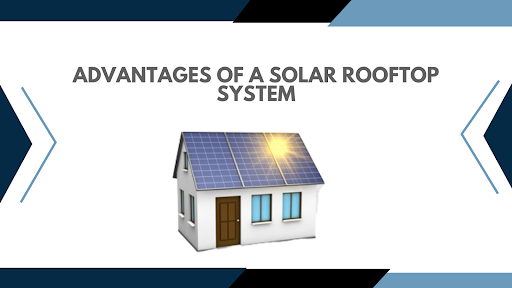
Businesses and homeowners generating their own electricity using solar may have some surplus energy that they can sell by feeding it into the grid. With net metering, this amount is offset against their current bill from their electricity provider. As solar power becomes increasingly popular, more and more customers are likely to benefit from the concept of net metering which is great for households and businesses, as well as the environment at large. Net metering is such an attractive concept, solar EPC companies in Mumbai and beyond are receiving endless queries about it. So in this blog, let’s simply explain what it is all about, and how it can benefit you.

What is net metering?

Net metering is a billing system wherein users of solar energy are credited for the electricity that they add to the grid. A user may not use the entire amount of electricity generated by the solar power system, especially during the day. If the house is net-metered, the solar net meter will run backward to provide credit for the electricity used at night or other peak usage periods. Customers are charged only for the “net” usage, and the exported electricity is used to serve nearby customers.

How net metering works

The solar power system of a customer is connected to the electricity grid through the main service panel and the power meter. When the solar system generates surplus electricity, it is transferred to the main grid through a bi-directional solar net meter. Sending out electricity reverses the meter from its normal direction. 

The simple billing mechanism of net metering is that customer only pays the bill for the “net” electricity consumed, that is, the difference between the power purchased from the electricity provider and the power returned to the grid. 

How it helps monetarily

Net metering is a great way to put a financial value on the surplus electricity generated by your solar power system. 

  • It brings down consumers’ cost of energy because the value of the surplus power exported is offset against that consumed. This can slash consumers’ electricity bills significantly.
  • No investment is required in an expensive battery bank. This is because net metering allows consumers to use the grid itself as a huge power bank that stores surplus power. A small backup should be enough for power outages.
  • The main components of a net metering system are solar modules and an inverter. Both components are highly easy and inexpensive to maintain, as there are no moving parts and hence little wear and tear. Modules in fact have a pretty long warranty period and are manufactured from semiconductor material. These are mostly protected by tempered glass.
  • With net metering, you can capture vital information like the consumption and export of electricity. This can help you understand your usage patterns and select just the right plans from your electricity provider. This can make your consumption more streamlined, efficient and cost-effective. 

For further information on net metering or any solar project, get in touch with VEMC at 022 43436655 or email us at marketing@vemc.co.in. We are one of the top solar installation company in Mumbai. You can also get in touch with us for solar power installation in Mumbai and beyond, and benefit from our excellent service.

A Pump Energy Audit By VEMC Lead To Substantial Savings For Its Customer

Pump Energy Audit for savings

An energy audit can be a great way to rein in the energy costs of your pump. This is not just important for businesses but also for the global society at large. Greater energy costs can severely hamper our efforts to create a more pollution-free and sustainable world. As per audit statistics, up to 60% energy that pumps consume can be saved. Replacing old pumps or spares after the energy audit can therefore save an incredible amount of energy. VEMC has unparalleled experience and expertise in energy audits and helps its clients remain efficient, cost-effective, and highly competitive in the market.

The procedure of the energy audit:

They say, “what cannot be measured, cannot be managed”. When going for client audits, VEMC measures three parameters: flow, differential head, and electricity consumed.

  • The flow is measured using a clamp-on ultrasonic flow meter.
  • Two pressure gauges installed at suction and discharge help measure the differential head.
  • A simple power meter can help measure the amount of electricity used by the pump.

VEMC provides measurement accuracy of up to +/-3%.

Assessment plan:

  • On-site inspection of pumping systems with relevant equipment
  • Collecting and punching data for parameters like flow, differential head, and energy consumed.
  • Generating reports that highlight current and potential areas of energy saving
  • Presentation of observation and implementation of the energy optimization regime

Performance assessment of pumps:

On one energy audit, VEMC found that the efficiency of the condenser pumps of a client was on the lower side. We recommended the following to the client:

  • Replace the rotating assembly for energy savings
  • Replace the 250 kW motor with an IE4 motor of the same capacity. These are more efficient, would reduce energy consumption, and boost output.
  • Since the pumps were operating 24/7, Corrocoat was the impeller for energy optimization.
  • Change the discharge line valves to control the discharge pressure of the pump as per the requirement

Carrying out these recommendations would cost the client a maximum of Rs. 29 lakhs (cost of rotating assembly = Rs. 12 lakhs, and IE4 motor up to Rs. 17 lakhs.)

Carrying out these recommendations had a significant impact on energy saving as well as cost-cutting.

  • The estimated savings in terms of flow at 32 m head of the same pump was 1820 cum/hr.
  • Likewise, the power consumed was reduced from 196 to 194.34 kW, which is an 8% energy saving.
  • The total energy saving of the condenser pump was 119084 per annum, which given the costs per unit (Rs. 10) translated into monetary savings of Rs. 1190840.
  • Given the savings, the Rs. 29 lakh investment on the pump was estimated to get paid back within a period of just 21.2 months or 1.8 years.

It is very clear that a VEMC energy audit shows remarkable energy-saving and cost-optimization results. To get your first pump energy audit conducted, get in touch with us at 022 43436655 or email us at marketing@vemc.co.in

Here are a Few Ways to Make Your Solar Installation Absolutely Safe & Secure

Safe And Secure Solar Installation

Solar energy is the future and a lot of homes are opting for it hoping to cut back on their electricity bills and receiving an uninterrupted power supply. But solar power installation must be done with a number of safety prerequisites in mind. The best solar company will take into account all factors like your building infrastructure like space or roofing and electrical connections before installation.

From the Electrical Point of View:

Before getting in touch with a solar energy company, track and keep a record of your monthly bills and the power drawn by your electrical appliances. You can do this using the energy calculator apps online. Usually, the monthly consumption in a typical urban household is 1-5 kW. Depending on your electricity needs, choose a solar power system of the right size. Standard solar panels have a 250 Wp (Watt peak) configuration, while larger panels can go up to 300 Wp depending upon the requirement.

Make sure the installer is connecting all the electrical wiring carefully and without leaving any glitches behind. A qualified engineer must supervise the process of routing the cables and it must be ensured that the cable is not damaged. Never touch the electrical wiring or contacts without proper protection gear or insulation.

The PV cells generate electricity by converting the sun’s energy, and the inverter converts the Direct Current (DC) from the panel into Alternating Current (AC). In case the components are “live” with electricity generated from the sun, they can cause an arc-flash electricity shock leading to severe injury or death. Make sure the system is properly earthed to prevent any such situations.

Make sure your solar power company is doing enough to protect your cables, say by using a flexible metal conduit when wiring through walls or if they are exposed to sun and rain outdoors.

Identify the Roof Structure, Type, and Material of the Roof:

Before you go for solar power installation, ensure that your roof offers ample space, has the right structure, and is made of robust material. Otherwise, mounting a heavy solar panel system can cause serious damage to your roof and accidental injuries to your family. Roof space is one of the primary factors to consider in metros, and is given the highest importance for instance by solar EPC companies in Mumbai.

The best roof for installing solar panels is a composite asphalt shingle roof. But by and large, solar panels are viable on most roof types except for wood shake roofs. The roof must ideally face south but in a country like India, as long as you have space for the panels, you’re good to go. Most places receive ample sunlight during the day irrespective of the direction of the roof.

When it comes to the ideal roof design for solar panels, the only rule is ‘simpler the better’. Roofs with lots of tiers, pipes, chimneys, and skylights can complicate the installation effort manifold.

If your roof is old or dilapidated, make sure you replace it before the installation. The old roof may not just be dangerous, it will cost double to dismount and then remount the panels when you eventually plan to replace it.

VEMC is a leading solar installation company. For solar panel installation in Mumbai, or for any information on solar power installation, feel free to get in touch at 022 43436655 or email us at marketing@vemc.co.in.

How to Install Mechanical Seal in an End Suction Centrifugal Pump

End Suction Centrifugal Pump

Centrifugal pumps have a rotating shaft that sticks out from the back of the pump casing through a seal chamber or stuffing box. The mechanical seal is needed to prevent fluid from leaking into the atmosphere along this shaft. Failure of these mechanical seals can have serious implications for the pump’s safety and reliability. It is therefore very important to install the seal properly.

How a Mechanical Seal Works in an End Suction Centrifugal Pump

A mechanical seal needs two smooth and flat seal faces in contact, one that is rotating with the shaft and another that is stationary with the casing. The faces are sealed to their holders using secondary seals. These are flexible so that they’re placed in contact and move to compensate for any misalignments or wear and tear. The faces however need lubrication to function at their best.

Steps for Installing a Mechanical Seal in Centrifugal Pumps

Here are 7 simple steps to follow when you are installing or replacing a mechanical seal in end suction centrifugal pumps:

1. Make sure the power is off

Make sure you cut the power so that the motor is not in motion. It’s even better to be doubly sure by cutting the main supply so that the motor may not start up while you’re working on it. 

2. Isolate the fluid from the pump

Next up, shut both inlet and outlet isolation valves and drain the pump casing by removing the drain plug.

3. Dismantle the pump

Use a wrench to unscrew the bolts holding the housing of the pump in place. Detach the pump carefully and keep the bolts safe for reassembly later.

4. Identify the stuffing box arrangement

If the pump is of the back pull-out design, remove the spacer element in the coupling, remove the casing bolts and pull the pump away from the casing. You can then access the seal without having to disconnect the casing from the piping. 

In case the pump is not a ‘back pull-out design, you’ll have to completely disconnect the pump after you disconnect the coupling between the pump and shaft. If the pump is a close-coupled design, you’ll have to remove the entire pump.

5. Remove the impeller

Dismantle the impeller of the pump. You can find the seal located on the shaft behind the impeller. Detach the shaft by holding it in place using a wrench and then rotate the impeller to unscrew it.

6. Detach the old seal

After removing the impeller, you can access both the rotary and stationary seal parts. The parts are usually held in place with screws all along the shaft. Remove the screw and pull away the rotary seal parts, and then remove the stationary part of the seal.

7. Replace the seal

Now place the replacement seal parts along the shaft. Push the stationary part into the casing using a new o-ring or gasket material. 
For any guidance on your centrifugal pumps, including all your sealing needs, feel free to speak to our experts at 022 43436655 or email us at marketing@vemc.co.in. We at VEMC are authorised Kirloskar dealer based in Mumbai and deal in a range of Kirloskar centrifugal pumps including multistage centrifugal pumps, (also called horizontal multistage pumps).

Compressed Air Industry Trends to Watch in 2023

Compressed Air Industry Trends

As more and more companies become energy and cost-sensitive, compressed air will emerge as one of the most favored ways to power tasks in factories and homes. In this blog, we take you through some of the most significant compressed air trends that customers and air compressor dealers must watch in 2023.

Here are the trends in the compressed air industry to look out for in 2023

1. Demand for Compressed Air Equipment Remains High

Compressed air is often the 3rd or 4th most favored utility in the manufacturing industry. As per a market analysis report, the global air compressor market stood at $32.02 billion in 2020 and is expected to grow at a CAGR of 3.4% from 2021 to 2028. Although the growth was somewhat tempered by the pandemic which caused a general slowdown across sectors, the post-pandemic world is ever more focused on energy efficiency, reducing costs, and cutting CO2 emissions. With the growing standard of living especially in the Asia-Pacific region, air compressors will see plenty of demand due to the rising use of air conditioners.

2. Lead Times Remain Longer than Normal – Especially for Steel Parts

A number of factors can affect the lead times of spare parts such as demand, stockouts, shipping delays, inefficient inventory control, and unnecessary processes. An Elgi compressor with its sophisticated design is made up of a number of small and large components. 

When it comes to the spare parts of your air compressors, you might experience longer than normal lead times. This is because most industries are just reopening after the pandemic, and with a sudden spurt in demand, mills will be looking to complete orders of priority sectors ahead of manufacturers of air compressor parts. This being a classic demand-supply problem, might even affect the prices of the spare parts, causing a bit of a concern to customers as well as air compressor dealers.

3. Compressed Air Supply Chains and Prices Are Stabilising

Compressor dealers have witnessed a serious disruption in business due to the pandemic. The complex designs and assemblage of a number of parts sourced from different manufacturers could make logistics for a typical Elgi compressor dealer rather challenging. But as the pandemic ebbs away, the global economy is recovering fast, most Elgi air compressor distributors would expect the supply chains and prices to stabilize once again.

4. Industrial Internet of Things (IIoT) Applications Are Coming for Compressed Air

The Industrial Internet of Things (IIoT) will have massive implications for preventative maintenance, performance tracking, and energy efficiency. Air compressors communicating over the internet can share the condition of their parts such as belts and motors. The enormous amount of data produced as a result will be handy in designing energy-efficient and high-performing air compressors. Monitoring will become remote and convenient as parameters like flow, pressure, speed, etc. will be available on mobile devices. 

VEMC is one of the leading ELGi Air Compressor Dealers in Mumbai. For details or any queries on Elgi air compressors, feel free to contact our experts at 022 43436655 or email us at marketing@vemc.co.in. We at VEMC are way ahead of other air compressor dealers with a proven track record of excellence. As the most reliable Elgi dealer, we are committed to swift on-call service and top-class preventative maintenance.

8 Ways To Improve The Efficiency Of Your Compressed Air System

Improve The Efficiency Of Your Compressed Air System

A number of factors can hold back your air compressor from performing optimally and giving you the best results at lower costs. Whether it is your compressed air filter or lubrication, everything must work seamlessly in tandem, enabling you to make the most of your compressor at limited energy inputs.

Here are 8 ways in which you can boost the efficiency of your Elgi air compressors and ensure they work for you.

Understand Lubrication

Like all other equipment in your facility, an air compressor consists of moving parts. To avoid wear and tear on these parts while they’re in action, lubrication is a must! However, both over and under-lubrication can create problems. Also, the quality of the lubricant must be chosen carefully to avoid damage to the machine. This is all the more important if you’re using your compressor in a sensitive line of work such as food processing or confectionery, as it can poison the consumables. Each system requires a specific type or level of lubrication and the safest way out is to go through the user manual and follow the instructions.

Know how Particulates Impact your System

Particulates can enter your Elgi compressor system, hamper its performance or even cause damage to the parts. All of this depends upon the atmosphere where an air compressor is being used and accordingly necessitates the use of a good quality compressed air filter, such as an Elgi air filter.

Prevent Compressor Contamination

Both moisture and particulate matter can be a source of contamination for air compressors. This can cause poor air quality of air being forced out from the compressor or damage to the internal parts of the compressor itself. To avoid this, regular inspection, the use of air dryers, or the right air filter for the compressor, is important.

Cooler Building Temperatures

Both increases and decreases in temperatures can cause the performance of an air compressor to plummet. This can be combated by regulating the temperature of your building using air conditioning, central heating, or natural ventilation.

Reusing the Energy you Create

Sustainable use of air compressors can be ensured by avoiding wastage and making the most of the energy released. Air compressors release a lot of heat as they function. So make sure you tap this heat and utilise it well for some or the other function, in your building.

Keep your System Clean

All mechanised equipment requires regular upkeep and maintenance to ensure optimum performance. Air compressors are no exception. Inspect and replace the compressed air filter frequently and clean the inner parts regularly to keep the system in its best shape.
Whether it is replacing your compressed air filter or scheduling an audit for your compressor system, we can keep a close watch on all your maintenance parameters. We are the leading Elgi air compressor dealers in the country, and pride ourselves on having a rich industry experience of 72 years. So get in touch with VEMC –– the most reliable Elgi compressor dealer in Mumbai out there, and book an audit at 022 43436655 or email us at marketing@vemc.co.in.

When To Add An Air Dryer To Your Compressed Air System

Air Dryer in Compressed Air System
Air Dryer

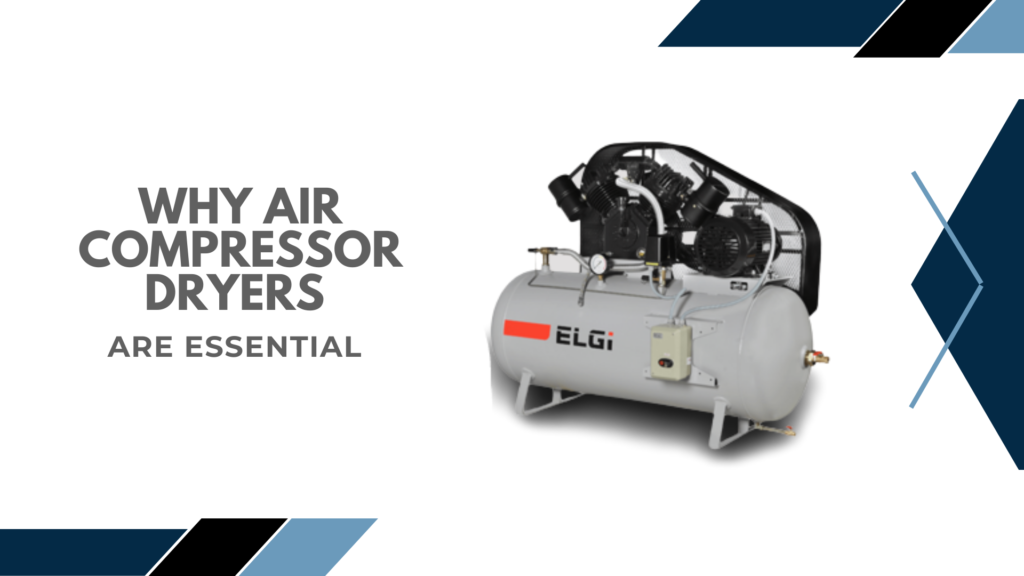
If you own an air compressor, you must have come across lots of suggestions online or otherwise, of adding an air dryer to it. This is because moisture in compressed air can be quite harmful to your machinery and some moisture-sensitive business operations as well. The degree of harm of course varies from one business operation to another. It can cause moulds or rust to develop over the metallic parts of your equipment (including the air compressor itself) and significantly reduce their working life and also affect their performance. Well, this is where an air dryer comes in!

An air dryer effectively saps the moisture from the compressed air, helps you prolong the life of your machinery, and also performs the tasks at hand perfectly well. In this blog, we take you through all that you need to know about air dryers in your compressed air system. 

What type of air dryer do you need?

Your choice of an air dryer for your compressor depends largely on the function you want it to perform and also your geographic location. Your Elgi compressor dealer in Mumbai will typically take you through the two types of air dryers that use these mechanisms: 

  • Desiccant air dryers: These are best suited for typically cold climes where the risks of freezing are quite high. These air dryers use desiccants such as silica gel or activated alumina which suck the moisture from the air as it passes through the compressor system. These can also be put to effective use in cold storage of pharmaceutical or food processing companies.
  • Refrigerated air dryers: In this type of air dryer, a refrigerant chills the air down to sub-zero temperatures. This freezes any moisture present in the air which is then removed before rewarming the air and pushing it through the piping to finally use it for the operation.

Selecting the right air dryer for your application

Moisture can cause serious damage to your equipment and in fact your air compressor system. But besides that, some business or industrial operations may require absolutely moisture-free operation and atmosphere. According to one estimate, moisture-related damages lead to the discarding of approximately 10% of all containerized goods. For instance, moisture can be a cause of serious losses in confectioneries, dry fruit, or wafer packaging operations. If you’re using a compressor in such facilities, therefore, you must ensure the complete removal of moisture from the compressed air.  Most air compressor dealers will recommend an Elgi air dryer –– a fantastic product that can come to your rescue when it comes to getting rid of unwanted moisture in your compressed air.
Make sure you’re purchasing an Elgi compressor or Elgi air dryer, only from authorised Elgi air compressor dealers who have both the product and the technical expertise for servicing it. VEMC is one highly acclaimed Elgi dealer that deals in both Elgi air dryers as well as Elgi air compressors and has a rich industry experience of over 72 years. If you need help finding the right compressed air dryer for your requirement, feel free to speak to our experts at 022 43436655 or email us at marketing@vemc.co.in.

Cutter Pump VS Grinder Pump: What’s Best for Sewer Systems?

Cutter Pump VS Grinder Pump

Your choice of pump has to depend on the operations you want to perform with it. Today, there is a wide range of options available, each pump suited for the right kind of task. When it comes to sewage pumps, two options that clearly stand out are cutter pumps and grinder pumps. Both essentially perform the same function of cutting down solid or semi-solid waste to prevent clogging. Only the technique differs. In this blog, we take you through the various aspects of both these options you need to consider before choosing it for your facility.

Clogging problems in sewage treatment

Flushable products like wet wipes, toilet paper, and scrub pads are offering a great deal of convenience to consumers these days. However, these also pose serious problems to city drainage systems as they lead to severe clogging. This can be extremely difficult to handle and can lead to an enormous amount of expenses for the repair and restoration of the drains.

Centrifugal pumps are unable to deal with this flushable material as they are designed with a rotating impeller. This has critical tolerance which makes it extremely difficult for solids to pass through. Thus, old rags, ropes, clothes, and cans can get stuck in the drains. As flushable products are fast becoming a part of our urban life, cutter or grinder pumps have also become indispensable.

Cutter pumps

These use a sharp cutting blade made of tungsten carbide that is attached to the impeller and cuts down solid or semi-solid sewage into smaller pieces of nearly 25 mm each. They can deal pretty well with rags, toilet paper, plastics, and cleaning products, thus preventing clogging of your drainage.

Grinder pumps

As opposed to cutter pumps, grinder pumps follow the mechanism of grinding the waste. A blade rotates inside a cutting ring that has multiple teeth. This way, solid or fibrous matter is ground down to finer pieces that can then be easily discharged out of the drains. These pumps can typically handle larger and more diverse materials as compared to the cutter pumps.

Cutter pumps vs Grinder pumps

These are energy efficient and low-costThese are expensive and less energy-efficient
These can deal with smaller sewageThese can cut down larger pieces and more diverse material
These are suitable for industrial operations as well as municipal useThese are best suited for large industrial purposes where sewage may be tougher and more voluminous
These have a wider head and flowThese have a narrower head and flow
Oil and grease can pose some difficulties These consume too much energy and may require screening of solids

The best choice to deal with clogging is Kirloskar’s CWC cutter pump. It is a robust, multipurpose pump that is well-suited for industrial and municipal purposes. Kirloskar cutter pump is also highly energy efficient and causes a minimum environmental impact. The maintenance is easy and highly inexpensive. 

For more information on pumps for sewage treatment, get in touch with us at 022 43436655 or email us at marketing@vemc.co.in. VEMC is an authorised Kirloskar pump distributor with a rich industry experience of over 72 years.

Centrifugal Pumps are Energy Guzzlers. How does Pump Energy Audit Help?

Centrifugal Pumps

A centrifugal pump can seriously raise your energy costs if you’re not keeping tabs on its efficiency levels. It is necessary that you take timely measures to eliminate inefficiencies or replace the pump altogether as the last resort. The most effective method in this regard is a thorough energy audit that can bring forth all the irregularities or issues with the pump’s performance. It can also give an estimate of energy savings if you switch to a different pump. In this blog, we talk about how an energy audit of your centrifugal pump can contribute to significant savings and cut down on costs.

Costs of Pumping

Pumping is a rather expensive affair across the world and more so in an energy-strapped developing country like India. According to some estimates, pumps consume 10% of power across the world, and switching to a more efficient water pump could save up to 4% of electricity globally. 

The main reasons behind the high costs of pumping could be an inappropriate selection of pumps, old inefficient design, improper layout, etc. By switching over to a more energy-efficient pump, you can reduce your bills, increase productivity, boost profits and enhance business competitiveness.

Centrifugal Pumps Consume a Lot of Power

Centrifugal pumps consume anywhere between 25% and 60% of a plant’s electrical motor energy. This can be made worse if the pump is improperly sized or poorly performing. Lack of maintenance and poor condition of the pumps is other reasons for the spike in running costs of a pump. This requires proper matching of a pump of the right capacity with the operation at hand. Likewise, a properly scheduled maintenance regime is a must to eliminate inefficiencies and overdrawing electricity over the lifespan of the pump.

Steps to Follow

An energy audit is the best way to keep the rising electricity costs in check. It is highly beneficial for business, society, and the environment at large. A pump energy audit is conducted by following these steps:

  1. Shortlist all the pumps for the audit
  2. Measure parameters like flow, pressure, and energy consumption
  3. Calculate the pumping efficiency
  4. Discuss the case with a specialist like an engineer or the maintenance staff
  5. Analyze data
  6. List recommendations and present them in the final report

How you can Save Energy

After an energy audit, you can get an in-depth understanding of the gaps, and the affirmative action that must be taken to fill them. With comprehensive data collection, analysis and modeling, it also gives you an idea about how much you can save by switching to a new alternative. In most industrial pumping systems, energy audits can help save up to half the energy costs!
VEMC can take care of the energy audit services of your pumps. We have all the expertise required to carry out Performance Measurement and energy optimisation of pumps and motors. Our team can provide a superior analysis of your current energy consumption and also the annual expenditure followed by a cost-returns-based proposal for different alternatives. For further information, feel free to call us at 022 43436655 or email us at marketing@vemc.co.in.

What To Know Before Installing Solar Project

Installing Solar Project

Solar energy is being received with enormous excitement across the country. Many homeowners are even able to save almost 100% of their electricity bills thanks to their solar panels. No wonder the installation of PV systems has grown exponentially from just 5 MW in 2010-11 to a whopping 5000 MW in 2019-20. However, the installation of a solar project on your roof has certain prerequisites which must be met to ensure it works at the optimum capacity. In this blog, we take you through all the critical ones.

Can your roof support solar panels?

First things first, make sure your roof can provide the physical strength and stability to install solar panels and mounting structures which are typically quite heavy. Do not install the system unless your roof is firm. The possibility of your roof collapsing under the weight of the structure could cause serious injuries or even loss of life.

Is your roof the right shape and type?

The type of roofing you have also determined the possibility of installing a solar project. A tin roof with a sharp slope can pose serious challenges while installing the mounting structures and even then these might not remain stable. A terrace on the other hand can offer a great deal of convenience. Likewise, how much space is available on the rooftop is also crucial to consider.

Which direction does the slope of your roof face?

To generate the maximum amount of electricity, solar panels must face the sun for as long as possible. This makes the direction of the slope of your roof quite significant. The best placement for your panels according to most professionals is either south or west.

How efficient is your installation location? How much energy do you use?

The amount of power generated also depends upon the installation location. You would obviously want the sun to strike your panels for the most part of the day. But this also depends upon your energy needs from the solar panel. In case you rely almost completely on your solar panels for electricity, choose your location carefully. The technician should be able to help you find the right spot for the panels, and in case of prior installation, can also help move the installation to a different location.

How do you connect to the grid?

A number of things need to be taken into consideration with regard to your connection with the grid. These include the following:

  1. How long will it take to get the connection?
  2. Are you liable to pay any fee?
  3. Will your supplier enter into a net metering agreement for surplus energy that you feed back to the grid?

Solar installation at home or business could create a lot of confusion and dilemmas. The best way to get all your queries addressed is to contact the experts. VEMC is one of the top solar company in Mumbai that can make your life much simpler when it comes to your solar installation. Before you install or move your PV system, get in touch with our experts at 022 43436655 or email us at marketing@vemc.co.in.

How to Calculate Total Dynamic Head for an Industrial Pump

TDH for an Industrial Pump

The total Dynamic Head in an industrial pump refers to the total pressure when water is flowing in a particular system. It has two parts: the vertical rise and friction loss. In this blog, we explain to you the complete calculation of the TDH. So let’s get started.

Broadly, the TDH of a pump can be calculated by following these steps:

  1. Calculate the value of the vertical rise 
  2. Find out the friction losses in the system as the water passes through the pipe and other components
  3. Add both these values to arrive at the TDH.
  • How to calculate the vertical rise:

As the name suggests, this parameter seeks to calculate the distance up to which the liquid has to rise from its starting point in the system below to the endpoint. If the liquid level at the bottom goes down, the vertical rise will naturally increase. Likewise, in case the level of liquid rises at the bottom, it has to rise over a shorter distance to reach the endpoint, and hence the vertical rise will decrease. With the increase of the value of vertical rise, the TDH also increases.

  • How to calculate friction loss:

To find out the friction loss, it is necessary to calculate the desired flow. The greater the flow going through your pipes more will be the loss due to friction. Friction loss also depends on the type of pipe in use, its vertical and horizontal length, and its schedule. You must also factor in the elbows, valves, connectors, or other components that come in contact with the liquid, and hence contribute to the friction loss. 

  • The result: Total Dynamic Head calculation:

As stated earlier, TDH is simply the summation of vertical rise and friction loss. To arrive at the TDH value, first ensure both are in the same units of length, say feet. For instance, if the vertical rise in the worst-case scenario is 25 feet, and the friction loss of the system is 6 feet, the TDH value would be 31 feet.

  • Alternative scenario:

Always considers the worst-case scenario in case of vertical rise to ensure you have sufficient amount of TDH. For instance, in the above case, if the water level never goes below 5 feet, the vertical rise will always be 20 feet and hence the TDH value will only be 26 feet.

Other Considerations When Calculating Total Dynamic Head

A few other factors also have an impact on the Total Dynamic Head. These include viscosity, specific gravity, and temperature. The specific gravity of a liquid can slightly alter the friction losses. Likewise, viscosity can significantly increase friction losses. 
For any information on centrifugal pumps, multistage centrifugal pumps, horizontal multistage pumps, or vertical pumps, feel free to call us at 022 43436655 or email us at marketing@vemc.co.in. VEMC is the authorised Kirloskar dealer that deals in the entire range of pumps suited for various operations. VMC is an ISO 9001:2015 certified company with a rich industry experience of 72 years.

Solar Power Returns Are Better Than The Bank

Whenever you invest in a new source of energy, one of the most critical things you look out for is the returns you get. Energy inevitably involves finances and any savings you make on it are as good as earnings. A cursory look at our history tells us that the costs of energy never go down and on the contrary are always on the ascendant. The fact that your finances are intricately tied to your energy needs makes it all the more important to make the right decisions when it comes to choosing the source of your energy.

When it comes to solar power, you can actually calculate these returns to great levels of precision. In fact, these returns are actually so healthy that they can even exceed the interest yielded by your bank deposits. In this blog, we take you through a full-fledged calculation to prove how solar power returns are even better than your bank investment. 

Let’s do some simple math!

In India, the average rate of return on a fixed deposit across banks these days is 6%. The figure is obviously subject to changes in government policies from time to time, depending upon a number of macroeconomic factors. However, if you were to deposit an amount of Rs. 100,000 in a fixed deposit today, you would receive somewhere around Rs. 511 per month summing up to Rs. 6136 per year.

Now if you invest the same Rs. 100,000 in a solar plant, it will produce electricity of around 8 units per day at a place with adequate sunlight. The prevalent rate of electricity in India is Rs. 6 per unit (this is a very modest estimation as the rates are always growing by the day). This means you produce electricity worth Rs. 48 (8×6) per day and Rs. 1440 (48×30) per month. The total worth of electricity you will produce in a full year would be Rs. 17,520 (48×365). Solar power returns, therefore, are almost thrice the amount you will be receiving as interest on a fixed deposit of the exact same amount!

Solar means independence

Energy dependence is a major issue in our society and even politics today. Energy is basically the very lifeblood of our modern economy. With growing research & development in the field of solar power, we could have a unique opportunity to rid ourselves of our dependence on fossils and other conventional sources of energy. Solar being a perpetual source of energy, especially in a tropical country like India, energy independence won’t be such a far-fetched dream after all, if we are able to make the most of this abundant source. This also entails a lot of benefits for not just human societies but also the environment at large. Quite clearly, solar power is on many levels the fuel for the future!
For further information on solar payback or solar O&M, feel free to call us at 022 43436655 or email us at marketing@vemc.co.in. VEMC is one of the top solar companies in Mumbai. It is an ISO 9001:2015 certified company with a rich industry experience of 72 years.

Industrial Air Compressor Preventative Maintenance

Air Compressor Maintenance

Maintenance of equipment is necessary to ensure longevity and energy efficiency. This applies to air compressors that are used daily in an industrial setting. In this blog, we take you through some of the pressing issues with regard to the preventative maintenance of your industrial compressors.

Difference between preventative and standard air compressor maintenance

In an industrial setting, it is necessary to have an inspection regime in place to make sure your compressor and its allied equipment are functioning at the optimum level. This set of checklists or procedures is known as standard maintenance. 

Preventative maintenance on the other hand is all about finding and arresting mechanical issues before they spread and cause costly downtime. The schedule of preventative maintenance varies from component to component. While some may require daily inspections, others can be checked once or twice a year.

Benefits of preventative maintenance for industrial air compressors

  1. Avoids downtime: Downtime for any production facility can be costly for business and with preventative maintenance, this can be avoided to a great extent.
  2. Saves costs: Sudden breakdown of systems can cost more as compared to regular preventive checks.
  3. Ensures energy efficiency: Preventative maintenance brings to the surface any gaps or issues behind the sub-optimal level performance of the air compressor.
  4. Increases longevity: With regular check-ups, fine-tuning, and cleanups, an air compressor system can be kept in good health. This helps avoid fatal faults or wear and tear in the system and increases its life span.

Recommended preventative maintenance checks

  1. Oil filter: Oil must not be allowed to leave with the compressed air as it can corrupt the surface if the compressor is being used for spray painting. Oil filters must be checked weekly and replaced after every 4000-8000 hours of use. 
  1. Lubrication: Change the lubricant every 3 to 6 months to ensure the health of the compressor. Non-lubricated surfaces of the system could cause serious corrosion of moving parts.
  2. Air filter: Check, clean, and replace the air filter regularly. You do not want unclean air or air laden with particulates to come out of the compressor and hit a surface being spray-painted or cleaned with the compressor.
  3. Motor bearings: Make sure the bearings are sufficiently lubricated. Carry out regular inspections and check the bearings after every 4000 hours. Lack of lubrication can cause the bearings to get stuck in place.
  4. Intake vents: The air entering the vents can become dirty if the intake vents are lined with dirt, dust, and grime. The same air will then be released in compressed form.
  5. Belts: Belts must remain firm to ensure the proper functioning of the pulleys and connected parts. Replace the belts before they lose their tension or break down in the middle of a task.

Which maintenance checks should a technician perform

While some maintenance tasks can be performed in-house by your own team, for others, it is best you consult the compressor technicians. Some of these situations are

  • Replacement of motor
  • Relocation of heavy compressors
  • Safety shutdown instructions
  • In case of a mechanical breakdown

For operation and maintenance tasks of your air compressors by our skilled and qualified technicians, get in touch with us at 022 43436655 or email us at marketing@vemc.co.in. VEMC is the authorised Elgi air compressor dealer with an experience of over 72 years.

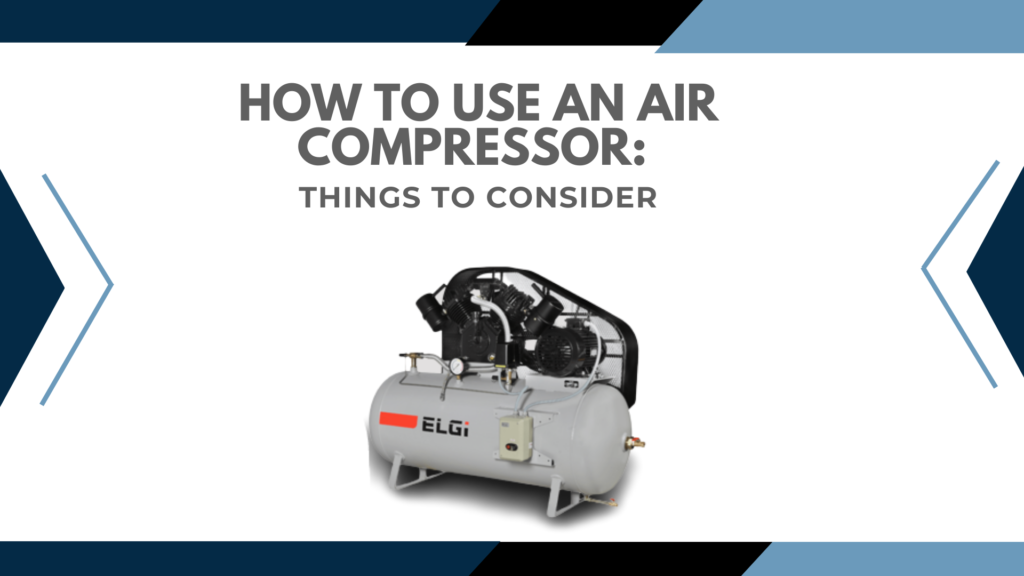
How to Use an Air Compressor: Things to Consider

How to Use an Air Compressor

A number of things need to be considered while using an air compressor for your operations. These include maintaining the right parameters like pressure, checking oil levels, having safety measures in place, etc. In this blog, we take you through all these aspects in detail.

Picking the right compressor for your needs

For domestic purposes, the most commonly used air compressor is the reciprocating piston type. This works by reducing the space to increase the pressure of the air inside the compressor. This is quite similar to the working of an internal combustion engine. 

For industrial purposes such as large refrigeration or pneumatic tools, rotary screw air compressors are mostly used. These work by compressing the air inside in a continuous sweeping motion, thus avoiding any pulsations that may occur in a reciprocating piston-type compressor. 

Getting started

  • Place your compressor in the right position. Ensure that the compressor is on an even and stable surface and the power source is always grounded. 
  • Turn the power on and allow your compressor to run for a minute. 
  • Set the psi as per your requirements. Adjust the pressure till you reach the recommended pressure for a particular tool. 
  • Connect the air hose and the tool you’re going to be working with. 

Oil and air intake

  • Check the level of oil in your compressor. Add oil by removing the cap and filling up to the mark if required.
  • Check the drain valve located at the bottom of the air tank. Make sure it is tightly closed.

Moisture and drainage

It is necessary to remove excess moisture from your air compressor at frequent intervals. This is usually done through the drain valve present at the bottom of the air tank. Wrench open the valve, allow the condensed moisture to flow out, and replace the valve. Always store the air compressor in a cabinet away from moisture.

Power

Make sure you turn off the compressor’s switch before you plug it into a three-pronged socket. As much as possible, avoid using extension cords if you’re unable to reach the spot of operations comfortably. Instead use an additional air hose and plug it into the first one. Extension cords can cause overheating of the air compressor. 

Meeting all safety regulations

  • Always use polycarbonate goggles and closed-toe shoes while operating the air compressor. 
  • Pull on the safety valve to test if it works.
  • Ensure you are only applying the right amount of pressure for a particular operation and as per the requirements of a particular tool. Try to maintain the pressure on a slightly lower side for safety.
  • Only operate the tool while there is air in the tank.

For more tips or information on how to best use your air compressor systems, feel free to get in touch with us at 022 43436655 or email us at marketing@vemc.co.in. VEMC is the authorised Elgi compressor dealer with an experience of over 72 years.

What is The Difference Between PSI and CFM in an Air Compressor?

If you’re looking for the right air compressor for your business, and are researching on the specifications of the product, you must have come across acronyms like PSI and CFM. These are necessary to tell you which size of air compressors are fit for your needs. Both these parameters are performance indicators of air compressors and other air-powered equipment. The main difference between PSI and CFM is that the former measures pressure and the volume of the latter measure. In this blog, we take you through a detailed understanding of both these metrics.

What is PSI?

PSI stands for pounds per square inch. Quite clearly it measures how many pounds of air occupies a square inch area. The greater the PSI value of a compressor, the greater pressure it is exerting and hence the more powerful it is considered to be. Quite simply, an air compressor with a PSI reading of 120 would indicate that it delivers 120 pounds of pressure per square inch. On an industrial compressor, the PSI value is typically displayed within the compressor system. As a convention ‘PSI’ is written in small letters. 

What is CFM?

CFM stands for cubic feet per minute. This indicates the volume or output rate of the air compressor in terms of cubic feet of air per minute. Simply put, it indicates how much air is being moved per minute. CFM is always measured at a particular PSI and increases proportionately along with the horsepower applied. Domestic compressors typically offer a volume of around 2 CFM while large industrial compressors that usually run at 200 HP, can deliver up to 1000 CFM of airflow. 

How are pressure and flow related in an air compressor?

To run an air compressor optimally, both volume and pressure must be sufficient. The principle isn’t very different from that of a garden pipe. When you squeeze the end of the pipe with your thumb, you are in effect reducing the space and creating less room for it to flow out. This will make the water shoot out farther. In air compressors, PSI and CFM relate to each other in a similar way. 

For the purpose of mathematical calculations, the relationship of pressure with volume in a compressed system can be demonstrated by Boyle’s law which states that:

P1 x V1 = P2 x V2

(P1 and V1 represent initial pressure and volume, and P2 and V2 represent final pressure and volume.)

The risks of over-pressurisation

Many times, users may over-pressurise the air compressors to ensure enough pressure is applied for a given task. This could pile up irrecoverable costs of energy losses since an increase in PSI value invariably increases the energy consumed. It can also reduce the lifespan of your equipment as the ‘artificial demand’ (another term for over-pressurisation) can cause unnecessary wear and tear.
For any questions regarding flow rates or accurate pressure levels for your air compressor systems, feel free to get in touch with us at 022 43436655 or email us at marketing@vemc.co.in. VEMC is the authorised dealer of Elgi air compressors with a rich industry experience of over 72 years.

Pump Energy Audit Leads to Substantial Savings

Pumps are an essential resource for several verticals such as the industrial sector, the hospitality sector, the agriculture sector, and the medical sector. As a result, they are extensively used in operations across industries. This also means that they consume a lot of energy to run efficiently. For example, in agriculture, groundwater pumping consumes about 16×109 kWh of electricity and about 2,000 million litres of diesel oil in a year. 

Pump energy audits reveal that around 30-50% of the total energy consumed from pumps can be saved. This means that if you replace your old pumps with new, efficient pumps, you can not only save energy but also significant energy costs. With rising energy prices, getting an energy audit done by professionals is a prerequisite. 

What is a pump energy audit? 

A pump audit is an energy optimisation audit of your pump system. It helps analyse the efficiency of your pump system and identifies energy-saving options through switching to a new pump or pump line. Additionally, it also illustrates the monetary benefits of the switch for your company. 

There are several reasons why your pumps can have lower efficiency:

  • Undersized pipes (less initial cost but high frictional head loss and operational cost)
  • High delivery point (excessive height increases energy consumption)
  • Poor fittings (leads to leakage and losses)
  • Inefficient pumps (due to improper selection and mismatched prime movers)

Benefits of a pump energy audit

Investing in an energy audit can be beneficial for your company as well as the environment. Here are the advantages of energy optimisation for your organisation: 

  • Reduced energy bills (up to 40%)
  • Lower operating costs
  • Low pump failure rates
  • Shorter payback periods
  • Reduced need for fuel imports
  • Conservation of insufficient resources
  • Building a sustainable environment

VEMC’s check parameters

With VEMC’s energy audit, you can unlock hidden savings from your pump installation and bring down pump operational costs. The three parameters of energy optimisation that VEMC aims to help your organisation achieve are energy consumption, service maintenance, and purchase price.

Steps to achieve energy efficiency by VEMC

To unlock the hidden savings, VEMC does an energy check that comprises the following aspects:

  • On-site inspection – A 3-4 hour survey of pump installations with a focus on key parameters such as age, head, and power consumption. 
  • Energy check report – The findings from the inspection are documented in an energy check report. The report offers details on pump installation, recommendations, savings, investment, and pay-back period.
  • Savings – In this step, the report is presented and recommendations are discussed, along with a plan of action. This happens in a 1-2 hour meeting. 

How to save pump energy?

The various ways you can achieve energy savings for your pumps are:

  • Choose a pump with the right dimensions and avoid oversizing
  • Trim the impellers to reduce pressure and flow
  • Investing in variable frequency drives to control motor movements as per situations
  • Use multiple pump systems
  • Optimise the system pipework to limit frictional pressure drop
  • Carry out routine maintenance for your pump systems

Why choose VEMC?

VEMC’s energy audit helps you understand whether your pump system is working efficiently or not and offers solutions to help reduce your carbon emissions and operating costs. This helps build a “No Cost and Low Cost” culture. 

For more information on conducting an energy audit for your industrial pumps, motors, and other equipment, feel free to contact us at +91 98199 07445. We would be glad to assist you in finding the best match for you based on your requirements. VEMC is an authorized dealer of Kirloskar dewatering pumps and provides end-to-end project management services to its clients. We are ISO 9001:2015 certified and a pioneer in the field of electromechanical engineering products, allied equipment, and services.

What is a VFD Control Panel?

Variable Frequency Drive or VFD are control panels that help control the speed of electric motors and feed pumps used in various industrial facilities. Each motor has a different frequency and voltage and hence, a separate VFD control panel is required to monitor and control them. 

With VFD panels, you can bring multiple motors with variable frequencies and voltages under one roof. This will also protect your motors from moisture, corrosion, dust, and other damaging elements. 

VFDs are a crucial part of any manufacturing plant. Without them, the plants will not be able to maintain their output consistently. It can also cause failures that can severely hamper the production capacity of the plant. 

Like other control panels, VFDs comprise a range of equipment such as:

  • Harmonic filters
  • Protective equipment such as relays, circuit breakers, and stabilizers
  • A bypass control to keep the VFD operational in all conditions
  • Programmable Logic Controllers (PLC) for advanced control
  • Communication equipment such as switches and modems
  • Temperature control equipment such as air conditioner or anti-condensation heater
  • Motor starters

Benefits of a Variable Frequency Drive (VFD)

Does your industrial facility need VFD? Absolutely! Here are the top 4 reasons why you should get a VFD for your manufacturing unit: 

  • Power switching and protection – VFD control panels act as an intermediary between the power source and your equipment. In case there is a short circuit or a power overload, it will cause the circuit breaker of the VFD to trip. This way, your drive or any equipment connected to the line will not get affected. 
  • Speed backup – The VFD panel doors usually have a frequency control potentiometer. This helps send command signals to the motor as per the operator’s settings. In case the VFD fails, a bypass switch helps keep the motors functioning.
  • Equipment protection – Any manufacturing plant workplace is filled with moisture, dust, and other damaging particles. It can be cumbersome to protect your equipment from these. Long-term exposure to these materials can damage the tools permanently. One of the major risks is chemical accumulation on the open connections that can negatively impact performance. Moreover, dirt accumulation can reduce the lifespan of the equipment too. 
  • Visual control – VFD panels can provide crucial real-time data on the drive’s energy consumption, frequency, and other diagnostic data that operators require. Operators can also use the embedded controls to shift frequencies or take precautionary measures as per the monitored values. 

NEMA Ratings

VFD control panels have different ratings from the National Electrical Manufacturers Association (NEMA). There are 13 ratings, some of which are: 

  • Type 1: General purpose, for indoor use, protection against solid foreign objects
  • Type 2: Similar to Type 1 but with extra drip shields
  • Type 3: Protecting the equipment from external weather conditions such as rain
  • Type 3R: For outdoor use
  • Type 4: Water-tight, shielding equipment from at least 65 GMP of water

You can choose a specific protection by VFD panels based on the NEMA guidelines for the best usability and equipment protection. 

How can VFDs reduce energy consumption?

VFDs can reduce energy consumption significantly and help save production costs. Traditionally, motors would need valves and dampers to control pumps and fans. This would consume huge amounts of energy. VFDs can do the same without consuming so much energy. Moreover, the flexibility to adjust fan and pump speeds offers more control to operators to save energy. 

Why VEMC VFD panels? VEMC has all the resources you need to get the right VFD control panel for your system. Our excellent team of experts will offer end-to-end services right from the design selection to delivery, installation, and maintenance support. We are a 72-year young organization with ISO 9001:2015 certification and are CRISIL MSE-1 rated. We are pioneers in the field of electromechanical engineering products, allied equipment, and services. We will be happy to help you choose the right VEMC control panels for your manufacturing plant. Reach out to us at +919819907445.

Overview of Multistage Centrifugal Pumps: Here’s All You Need to Know

Multistage centrifugal pumps have been growing in popularity in recent years. Many engineers choose them because of their flexible flow range and excellent energy efficiency.

But are they a right fit for you? Let’s find out.

What are multistage centrifugal pumps?

A multistage pump is a category of pump that contains 2 or more impellers that can be of the same or different types. The impellers can be mounted on the same or different shafts. In case the outlets require high pressure, the impellers can be connected in a series. For high flow output, they can be connected parallelly.

What is the difference between a single stage centrifugal pump and a multistage centrifugal pump? 

The primary difference between single and multistage centrifugal pumps are the number of impellers or stages present. As the name implies, single stage impellers have only one impeller whereas multistage pumps have two.

The impeller of a centrifugal pump helps pressurise and transfer the liquid. Since multistage pumps have multiple impellers, they have better pressure ranges and flow rates than single stage pumps.

Where are multistage centrifugal pumps used? 

Multistage centrifugal pumps have a wide range of applications. They can be used for delivering water to high-rise buildings, reverse osmosis (RO), boiler feeder water, high pressure cleaning, water works, fuel delivery, oil and gas production, mining and other industries where high pressure and temperature are necessary factors.

What are the different types of multistage centrifugal pumps?

There are several kinds of multistage pumps: 

  • Horizontal Multistage Centrifugal Pump
  • Vertical Multistage Centrifugal Pump
  • Submersible Pump
  • Horizontal Split Case Pump
  • Vertical Turbine Pump

What are horizontal multistage centrifugal pumps?

Horizontal multistage centrifugal pumps are those that have two or more impellers and where the liquid travels horizontally. In this case, each stage acts like a separate pump. These are ideal for services that require moderate to high Total Dynamic Head (TDH). A single horizontal shaft can house up to eight stages. 

What are vertical multistage centrifugal pumps?

Vertical pumps are not that extensively used as horizontal pumps and have limited applications. As the name implies, their orientation is vertical where the impellers are placed on top of each other. The clearances in vertical pumps are also smaller than horizontal ones which makes them suitable for clean water applications. Moreover, if there’s a floor space crunch, these pumps can fit in well too.

For more information on industrial pumps, motors, and other equipment, feel free to contact us at +91 98199 07445. We would be glad to assist you in finding the best match based on your requirements. VEMC is an authorized dealer of Kirloskar multistage centrifugal pumps and provides end-to-end project management services to its clients. We are ISO 9001:2015 certified and a pioneer in the field of electromechanical engineering products, allied equipment, and services.