
VEMC-Blogs

Pump Guide: How to Overcome the Biggest Problems with Pump Life

Sudden pump failures can disrupt your business and delay project delivery. The hidden cost of breakdowns, owing to business loss, may exceed the preventive maintenance costs of the pumps. Pumps often face delivery failure, priming failure, excessive vibrations, reduced capacity, overload, and loss of displaced liquid. In this blog, we talk about factors affecting the pump life and ways to overcome their challenges.

  1. The type of liquid being pumped: Your quest to prolong your pump life starts with determining the liquid pumped in it. Factors like temperature, viscosity, suspended particles, acidity, etc., of the liquid, are crucial in determining the pump’s ability to withstand exposure.
  2. Material of the pump body: After testing the nature of the liquid, which maintains constant contact with the body of your pump, consider the material of your pump body. Can the pump material withstand contact with a specific type of liquid?
  3. Role of the pump: What’s the usage of your pump? Anticipating the usage of your pump can help in choosing the right one. Pumps play a critical role in some industries, and it is, thus, unwise to use an average pump. Similarly, find out if your business operations require a standardized pump operation or additional features that are available only in specially designed pumps.
  4. Always ensure pump inlet: You must never allow your pump to starve, which is the leading cause of pump seizures. To determine the inlet pressure, you must regularly take the Net Positive Suction Head (NPSH) reading and ensure the NPSH available (NPSHA) exceeds the NPSH value of your pump.
  5. Pump location: The immediate location and surroundings of the pump operation are crucial. Pumps operated outside need special care with regard to temperature and environment. You may need to protect the pump using special shelters or protection closets if there are apprehensions.
  6. Flow rate and pressure: The flow rate and pressure of the displaced liquid is an important consideration. It determines the size, length, and material of the inlet and outlet pipes. Their capacity must match the pressure requirements of the pump’s functions.

An understanding of these aspects affects the depreciation of your pumps and prolonging their valuable life.

For further information on industrial pumps, motors, and other equipment, contact us on +91-9819907445. As a leading industrial water pump suppliers in Mumbai, we would be happy to assist you in finding the best match based on your requirements. VEMC is an authorized Kirloskar dealer. It is ISO 9001:2015 certified and a pioneer in electromechanical engineering products, allied equipment, and services.

HYPN System: An Intelligent Water Supply Solution for Commercial Buildings

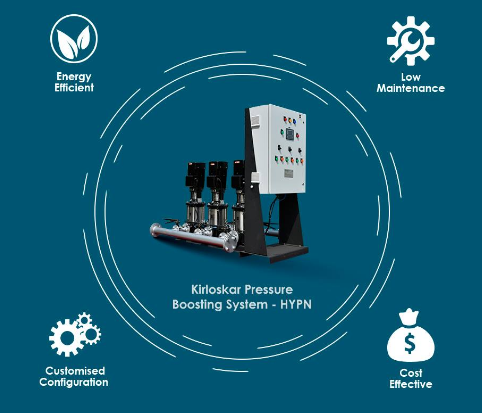
Kirloskar has come up with a state-of-the-art solution, known as the Hydro-Pneumatic (HYPN) system, for maintaining constant water pressure and serving changing water demand in buildings automatically. It predominantly finds use in commercial facilities such as hotels, hospitals, and industries. HYPN simply converts conventional pumping systems into a smart, responsive, and highly efficient automatic pumping systems.

As soon as the pressure falls below predetermined levels, the HYPN system turns on the motors to maintain a constant pressure level. On the other hand, it also eliminates the unnecessary functioning of the pumps. The HYPN system is low maintenance and durable, making it a highly cost-effective system. Due to its ability to match the pressure exactly with the demand, the HYPN system can also control the energy consumption, further reducing the cost. 

Apart from the cost benefits, Kirloskar has added a significant feature to the HYPN system. It integrated with remotely accessible smart devices, like mobiles and iPads, which enables customers to monitor various parameters of the HYPN system without physical presence. Its predictive analysis prepares customers about the likelihood of errors and breakdowns in advance. This further reduces the hidden costs associated with sudden breakdowns and unforeseen repairs. Besides, the remote monitoring system also eliminates the need for physical checks by field inspectors, thus, lowering human resource costs.

HYPN system is only as effective as its pumps. Kirloskar offers a wide range of pumps to work with the HYPN system and meet the clients’ unique needs. Inline, end suction, sump pumps, split case pumps, and VT pumps, among others, work seamlessly with the HYPN system. This enables the HYPN system to adapt to several industry verticals, like pharmaceuticals, mining, textiles, steel, railways, hotels, metros, etc., for their distinct requirements.

Kirloskar has been awarded India’s prestigious accreditation for HYPN, namely the India Design Mark (IDM), which symbolizes product excellence in quality and innovation. It is the country’s first HYPN manufacturer to receive this accreditation, which speaks volumes about the tremendous planning, research and development, innovation, and quality assurance while manufacturing this unique pumping system.

Lately, Covid-19 hospitals in Delhi, Uttar Pradesh, and Kerala found extensive use for KBL’s HYPN system in maintaining the water supply at their facilities.

For further information on industrial pumps, motors, and other equipment, contact us on +91-9819907445. As a leading industrial water pump supplier in Mumbai, we would be happy to assist you in finding the best match based on your requirements. VEMC is an authorized Kirloskar dealer. It is ISO 9001:2015 certified and a pioneer of electromechanical engineering products, allied equipment, and services.

How To Calculate The Right CFM or Airflow For Air Compressors

CFM is the short form of Cubic Feet per Minute (cu ft/min) and as is evident, it has a volume and a time dimension to it. CFM is, in fact, a measurement of how fast air flows into or out of space. The higher the CFM, the higher is the pressure exerted by the tightly compressed air on a pneumatic tool.

Analogous to power, CFM reflects the compressor’s ability to perform work over a certain period of time. While there is no doubt that CFM is a very useful metric of your compressor’s performance, there is, however, a need to understand the concept and arrive at accurate calculations.

Let us first try to understand the relationship between CFM and PSI (Pounds per Square Inch). While the two may seem conceptually alike, they have fairly distinct implications. CFM is the rate of flow of compressed air through a given space. It has a time dimension and is, therefore, a more dynamic metric. On the other hand, PSI is more static and is basically a measure of the pressure created by the compressed air per unit area. CFM is the driver behind PSI, which in turn reflects the Force that a compressor can exert and the amount of work it can get done. Both CFM and PSI determine whether an air compressor can meet your workload demands as each piece of equipment has its own airflow requirement.

There are a number of websites and online calculators that offer a simple and quick calculation of CFM. All you need to do is to enter the variables and within a split second, you arrive at your CFM. However, to gain a deep conceptual understanding of CFM, it is always advisable to do some good old math and arrive at the results through a formula. So, here we go:

CFM = Tank Volume in Cubic Feet x Standard Pressure (ATM) during a Cycle x Cranks per Minute

How to calculate Standard Pressure and Cranks per Minute?

Standard pressure must always be converted to PSI. Remember, 1 ATM = 14.7 PSI

Let’s say, your tank volume is 18 Cu. Ft, Standard pressure is 2 PSI and Cranks per Minute is 1.5.

By simple multiplication of the above-given variables, we get:

18 x 2 x 1.5 = 54 CFM

Another very easy method of calculating CFM is the airflow meter. This gives us the pressure coming out of a fitting and can be installed on individual pieces of equipment or complete systems to provide an instant reading.

For assistance to decide on the air compressor that suits your needs the best, feel free to contact us on +919819907445. We would be happy to assist you in finding the best match based on your requirements. As one of the leading Elgi air compressor dealers and distributors, VEMC provides seamless services to its clients. VEMC is ISO 9001:2015 certified and is a pioneer in the field of electromechanical engineering products, allied equipment, and services.

Overview Of Multistage Centrifugal Pumps: Here’s All That You Need To Know

Your usual centrifugal pump can restrict the pressure limit due to the design constraint of a single impeller. However, a Multistage Pump has two or more impellers of the same or different types, i.e., low Net Positive Suction Head (NPSH) suction impeller, double suction impeller, or centrifugal first stage and side-channel impellers.

The design of a Multistage Centrifugal pump is similar to the usual centrifugal pump, except for the multistage parts that channel fluid into the impeller’s eye. The impellers face in the same direction, and this generates a strong thrust. However, this creates a thrust balance, which keeps the thrust down at levels manageable by standard-sized thrust bearings. 

The working mechanism of a multistage centrifugal pump amplifies the thrust at previous levels to move forward. The thrust created by one impeller is cascaded by the next one, causing a build-up of thrust through the stages. The required number of impellers varies as per the final pressure required. The impellers are positioned in a sequence from left to right and the liquid is pushed with continuously rising pressure.

The Multistage Centrifugal Pumps find uses in diverse fields due to their pressure. These are great to pump water against gravity and can be used on constructions on the top floors of a skyscraper. They are also used for spraying and high-pressure cleaning in automotive and allied industrial works. Production of oil and fuel delivery to distant locations also requires high pressure, which Multistage Centrifugal Pumps can manage effectively.

A Multistage Pump is expensive and has a more complex design than the high-pressure duty pump. However, the Multistage Pump is a clear winner in efficiency and reliability. The great thing about these pumps is their uniquely flexible capacity. You can also configure it to have an inter-stage bleed off if you require high pressure at different points and in different directions. You may also run it at varying speeds to improve efficiency. Running the pump at a lower speed reduces noise, which is an important environmental consideration.

Multistage Centrifugal Pumps are available in different variants such as horizontal, vertical, submersible, side-channel pump, and vertical turbine pump. Which Multistage Pump you choose depends entirely upon your requirement and working environment.

For further information on industrial pumps, motors and other equipment, contact us on +91-9819907445. As a leading industrial water pump supplier in Mumbai, we would be happy to assist you in finding the best match based on your requirements. VEMC is an authorized Kirloskar dealer. It is ISO 9001:2015 certified and a pioneer in electromechanical engineering products, allied equipment, and services.

Smart Ways To Enhance Pump Performance & Reduce Energy Costs

Your electricity bills are likely to be expensive if your pumps are not efficient, despite low productivity. In this blog, we will touch upon 10 effective ways to enhance your pump performance and reduce energy costs.

Periodic maintenance:

Your pumps have many moving parts, which could lead to unnecessary friction, wear and tear, noise, and overheating. Therefore, it is important to carry out preventive maintenance by regularly checking parts, like bearings, impellers, packing seals, mechanical seals, etc.

Regular monitoring:

Every part that is vulnerable to faults or troubles must be given special attention and replaced in time. Damaged impellers, clogged pumps, and choked suction pipelines are some problem areas that require keen monitoring.

Use of automated controls:

Instead of physical supervision, you can monitor the parameters remotely through your devices. This helps to enhance the pump’s operational efficiency. KBL’s KirloSmart solution allows remote monitoring of your pumps through the KirloSmart mobile app. 

Avoid excessive heating:

Excessive heating may damage heat-sensitive parts and cause overconsumption of energy. Trimming the pump blades reduces energy generation and eliminates excessive heat.

Match pump capacity with operational needs:

Accurately calculate the required flow rate and try to match the pump capacity with it. Efficiency can drop significantly in case of a mismatch.

Install perfectly sized pumps:

Having a pump that is either too small or big can affect efficiency. If a pump is too small, the enormous pressure to process waste can cause overheating or breakdowns. On the other hand, if the pump is too big, it may have to be throttled to prevent it from running at full capacity. 

Optimize flow rate and head:

This is of paramount importance if you want to ensure high performance and efficiency, and reduce energy consumption.

Use VFDs:

A Variable Frequency Drive manages motor speed. Therefore, rather than operating at a steady speed, irrespective of the load, use VFDs to enhance efficiency and reducing consumption.

We hope these will help you cut down your power bills while making pump operation more efficient.

For further information on industrial pumps, motors, and other equipment, contact us on +91-9819907445. As a leading industrial water pump supplier in Mumbai, we would be happy to assist you in finding the best match based on your requirements. VEMC is an authorized Kirloskar dealer. It is ISO 9001:2015 certified and a pioneer in the field of electromechanical engineering products, allied equipment, and services.

Solar Farms- The Next Big Thing In Solar Space

Large-scale solar installations are great for Economies of Scale. In fact, Solar Farms that produce less than one megawatt of power cannot justify their cost of development. Solar Farms are mostly set up in the hinterlands as crowded urban and commercial pockets never provide enough space for their development. To put things into perspective, the Solar Energy Industries Association of the US says that as of date, there are around 12000 major solar projects generating over 166 GW of energy in the country. This mushroom growth of huge Solar Farms is expected to replicate across the world, especially in India that is both a tropical country and has a vast hinterland offering ample space for these projects.

As our energy preferences shift away from fossils, Solar Farms will attain greater significance due to the scale of production, lower costs per unit of energy and other significant benefits that we cover below:

A massive engine of clean energy:

Solar Farms unlike small solar installations have the potential to power townships, villages and even cities in the foreseeable future. You can envision a Solar Farm just like your good old hydro-power project or a thermal power plant. With increasing R&D in the sector, you can expect Solar Farms to be more productive, efficient and feasible. 

The dawn of Agrovoltaics:

Agrovoltaics is beginning to percolate the vocabulary of the Solar Sector. Unlike conventional installations like thermal plants or hydro-power plants, establishing a Solar Farm is not permanent or irreversible. This means the land covered under solar panels and other apparatus can always be re-used for agricultural purposes. Imagine the implications it has on the flexibility of the government’s planning and policy-making.

Energy for everyone:

Solar systems have a significant space factor associated closely with them. This means households or commercial facilities with inadequate space will never be able to accommodate a solar system on their rooftops or batteries in a dedicated room. This issue is however resolved by the Solar Farms that become the singular source of energy to power considerably large settlements from a distance.

No noise or other hazards:

Solar Farms go easy on the environment in more ways than one. They not just have zero emissions and can significantly help reduce our Carbon footprint as a society; they are also noise-less. Solar Farms get accommodated very naturally into your surroundings and have barely any effect on the communities, flora and fauna around them. These farms also do not release any hazardous wastes into the environment, quite unlike thermal and nuclear power plants.

For assistance to decide on the solar panel that suits your needs the best, feel free to contact us on +919819907445. We would be happy to assist you in finding the best match based on your requirements. As one of India’s best solar companies, having 72 years of market experience, VEMC provides end-to-end solar services to its clients. VEMC is ISO 9001:2015 certified and is one of the leading solar EPC company in India.

The Sun Is Up And Bright. Let’s See How We Still Face Challenges In The Solar Energy Industry

While Solar Energy is touted to be the fuel for the future, some significant challenges hinder us from making the most of this inexhaustible resource. However, as Solar R&D evolves, our hopes to tackle these challenges effectively will see a steady and upward trajectory. Having said that, the journey starts by identifying these challenges first, and in this blog, we do exactly that.

Dependence on nature:

Natural forces like seasons, geographical location and clouds determine the amount of Solar Energy that you can produce at a given time and place. This is absolutely beyond the control of humans and is likely to remain so, at least in the foreseeable future. Techniques to reduce the effect of these natural forces will have to be worked out so that users may bypass these challenges.

Quality of power:

This refers to the availability and voltage that solar systems can give us. Inconsistent power and fluctuating voltage are not acceptable, especially in commercial applications. This has serious implications for the reliability of this resource. For sectors that require emergency power such as healthcare, solar could struggle to find takers in the coming years. Only as the reliability-to-cost ratio improves in these areas will solar power will find greater acceptability.

Locational challenges:

Geography is a huge determinant in Solar Energy on more than one level. Globally, solar power fits best in the tropical regions that receive plenty of suns all year round. Latitudes further away from the equator will struggle to accommodate it. On a more local level, solar plants may have to be located in a large and open area, such as a desert or abandoned lands. This affects the availability of the resource to the human settlements, especially in urban areas that are in greater need of solar power.

Investment in Solar:

As a thumb rule, the first-time investment in any new technology is always hefty. This is also true of Solar Energy. There is a pressing need to bring all stakeholders such as government agencies, corporations and investors onto a common platform to develop an understanding and channel productive resources of the society into Solar Energy.

Cost of equipment:

The cost of installation of solar apparatus such as panels, storage batteries and VFDs is considerably high. This is quite a disincentive for taking up solar as your staple energy source, especially for households and small commercial undertakings. However, with the passage of time and with adequate research, innovation and competition pouring into the sector, the costs are expected to decline significantly.

Solar energy has gained tremendous traction lately, especially in the wake of the climate change debate. However, the formidable challenges faced on multiple levels require proper redressal through adequate research and development, innovation and investment.

For assistance to decide on the solar panel that suits your needs the best, feel free to contact us on +919819907445. We would be happy to assist you in finding the best match based on your requirements. As one of India’s best solar companies, having 72 years of market experience, VEMC provides end-to-end solar services to its clients. VEMC is ISO 9001:2015 certified and is one of the leading solar EPC company in India.

Compressed Air – The Fourth Utility Of The Modern World

If water, electricity and gas form the trio of essential utilities of the modern world, compressed air has a strong claim to be the fourth one. Air is one of the most ubiquitous resources of nature. When it comes to utilizing it as a source of energy, however, you have to compress and direct it with precision. Compressed air can drive wide-ranging activities and find use in a number of sectors. In this blog, we take you through the importance of this powerful source of energy across the economy.

Manufacturing:

Compressed air finds utility in a number of activities in the manufacturing sector. It powers the actuators, conveyor belts, sprayers and clamping equipment. It also supports casting processes, offers optimal product finishes and helps clean the final products impeccably. 

Construction:

Another sector that requires some heavy lifting and muscle power is construction. Compressed air is used to power pneumatic tools like buffing equipment, nailing, stapling and riveting guns, grinders, drillers, jackhammers and sanders. Lowering and raising heavy loads or demolishing structures also make use of compressed air. Tunnel-digging is another area where compressed air does wonder. They are used for road digging, cutting and cleaning. They also keep the tarmac, debris and other hard surfaces debris-free. 

Agriculture:

Pruning, harvesting, crop fertilising, seed sprinkling and spraying are some of the activities that compressed air helps with, in the agricultural sector. Air compressors power the tractors, sprayers, conveyors and pneumatic fruit pickers. They also facilitate the operation of hydraulic pumps.

Healthcare:

Compressed air is used for administering anaesthesia, power ventilators and other surgical machines in operation theatres. Compressed air is always free of contaminants, pollutants and other particulate matter, making it extremely useful to maintain an allergy and infection-free healthcare facility. Compressed air is also used to inflate emergency mattresses for patients.

Automotive:

In this sector, air compressors find great use in engine construction, assembling car bodies and giving finishing touches to the cars. Intricate components are put in place using compressed air-based pneumatic tools. Plasma cutting, welding and inflating tyres also use compressed air. Finally, the air compressors are used to clean the car and paint it using dry and oil-free compressed air to prevent bubbles or splattering to form on the surface.

The above-given list is not exhaustive and air compressors are used in multiple other areas of the economy. In the future, as the efficiency, precision and power of the pneumatic instruments is improved, air compressors are expected to find the greater application and have an increasingly enlarged role to play.

For assistance to decide on the air compressor that suits your needs the best, feel free to contact us on +919819907445. We would be happy to assist you in finding the best match based on your requirements. As one of the leading Elgi air compressor dealers in Mumbai, VEMC provides seamless services to its clients. VEMC is ISO 9001:2015 certified and is a pioneer in the field of electromechanical engineering products, allied equipment, and services.

What are the Different Types of Fire Fighting Pumps?

A fire can be a terrible hazard in any industry. At a power station, taking measures to prevent one as well as being prepared to deal with one in the event that it occurs, is absolutely crucial. Installing fire fighting pumps is an effective way to combat such a hazard. A fire pump is part of a sprinkler system’s water supply. It is powered by steam, electricity or diesel. Let’s examine some of the different types of fire fighting pumps that you can choose from, for your power station.

Sprinkler Pump

The sprinkler pump is commonly used to irrigate plants and greenery in gardens, and also to prevent fires. In a fire sprinkler system, the fire pump is an essential component. It provides access to high-pressure water in the fire sprinkler system, which serves to increase the rate of the flow of water. The sprinkler pump is a popular method of fire prevention in factories and power stations.

Booster Pump

The booster pump machine is part of another system to fight and suppress fires. A booster pump will increase the pressure of a fluid, which may be liquids or even gases, depending on its construction. A gas booster is much like a gas compressor but is usually built with a simpler mechanism, often with only a single stage of compression. This is used to increase the pressure of a gas which is already above the ambient pressure.

Jockey Pump

A jockey pump, also called a pressure-maintenance pump, is a small device that works with a fire pump in a fire fighting sprinkler system. It is designed in such a way that it keeps the pressure in the system raised at a certain level when the system is not in use, so that the fire pump does not have to run all the time and the system does not get set off without actual cause for alarm. The jockey pump helps make sure that your fire fighting resources are used efficiently, without wastage.

Drencher Pump

The drencher pump is another part of a fire fighting system which consists of water heads. Unlike sprinklers, which are built internally, drenchers are usually placed on the outside of a building to protect against a fire which may have broken out in a nearby building. Drencher pumps are found above windows, roofs and other exterior openings.

Water Curtain Pump

The water curtain pump is part of a water curtain system — another active fire fighting system. As the name suggests, a water curtain system forms a curtain of water in the event of a fire, to prevent the flames, heat or smoke from spreading further. A water curtain pump is connected to the nozzle of this system through a deluge valve. When fire or smoke is detected, a signal will be sent to the deluge valve to open up and switch on the pump. This will cause water to come gushing in and reach the nozzles and help put out the fire.

VEMC, an authorised Kirloskar pump dealers, supplies fire fighting pumps for different kinds of industrial purposes. We offer a diverse range of pumping solutions, including water pumps and containerised fire fighting pumps. For more information on our products, feel free to contact us on +91 98199 07445, and we would be happy to assist you. VEMC is ISO 9001:2015 certified and a pioneer in the field of electromechanical engineering products, allied equipment, and services.

Solar Success Story: The Installation of 200 kWp Plant at Godrej City

Navi Mumbai is a rapidly developing area, where new properties are being built. Godrej City is one such project by Godrej Properties. Located in Panvel, Navi Mumbai, it offers skillfully designed 1 BHK, 2 BHK, and 3 BHK apartments that are currently under construction. Godrej City consists of 568 units across 18 floors, spanning more than 3 towers over a total project area of 150 acres. Being a well-established solar energy company in Navi Mumbai, VEMC was consulted and hired to install a 200 kWp grid tied solar power plant at this location.

Challenge

Godrej City, being a booming residential estate, was seeing extremely high levels of electricity consumption. In fact, the annual average electricity production was 260000 kWh. VEMC’s solution sought to bring this down significantly and provide a greener, more sustainable and efficient source of energy.

We were met with the challenge of installing solar modules on “sandwich” roof profiles that don’t allow penetration of the sheet when anchoring the solar mounting arrangements. 

Further, this took place during monsoon and the COVID-19 pandemic. We were working at the site with our teams through this and all precautions had to be taken to ensure our safety. 

Our Solution

We took on the challenge and set about working out a solution. The project was a 200 kWp grid tied solar system. A grid-tied solar system is connected to the electrical power grid. The system relies on this grid to produce solar energy which can be used and funnels the excess energy to be used at a later time, or for net metering or clean energy credits.

The solar plant we successfully installed consists of 514 units of 390Wp high-efficiency Mono PERC modules. 

We solved the problem posed by the sandwich roof profiles by using high-strength industrial metal to metal adhesives to connect the mounting arrangement and roof.

The team was equipped with PPE kits and a thorough set of safety harnesses. This may have slowed them down but it protected everyone from both COVID-19 and other accidents.

Impact

The amount of carbon dioxide saved each year by avoiding fossil fuels to generate the same amount of energy is 184 metric tons! To get a clearer picture of the impact, this is equivalent to:

  • Greenhouse gas emissions from 40.1 passenger vehicles driven for one year and 463,075 miles driven by an average passenger vehicle
  • Carbon dioxide emissions from 20,733 gallons of gasoline consumed, 18,100 gallons of diesel consumed, 203,657 pounds of coal burned, and 2.4 tanker trucks’ worth of gasoline
  • Carbon sequestered by 3,047 tree seedlings grown for 10 years, 226 acres of forests in the USA for one year, and 1.3 acres of forests preserved from conversion to cropland in one year

The project expected payback is approximately 3 years, taking the maintenance expenses into consideration. VEMC is a well-established solar power plant company in India. With over 72 years of industry experience, VEMCO Solar was able to execute the Godrej City project successfully. VEMCO Solar is a market leader in solar solutions — be it solar plant erection, procurement, commissioning, net metering, or electrical connections. If you have any requirements in this space, please feel free to contact us at +91 98199 07445. We would be happy to help you out.

The Role of Air Compressor in Oxygen Cylinder Plant

Air compressors are used in numerous industrial applications, including healthcare products, food and beverages, petrochemicals, and nuclear power. Oxygen plants are industrial systems that are designed to generate oxygen, and compressed air plays a pivotal role in these. Typically, air compressors use air as a source of fuel, using pressure swing adsorption (PSA) or membrane separation techniques. Let’s take a closer look at the main types of air compressors that are manufactured and offered by ELGi.

Oil Lubricated Screw Compressors

The range of oil-lubricated air compressors from ELGi equips you with long-lasting and cost-effective compressed air solutions. An air compressor that is oil-lubricated draws air into a storage tank with a screw that requires oil in order to keep the production process running smoothly. They are relatively quieter than other ELGi air compressors and have long durability.

ELGi’s collection of oil-lubricated rotary screw air compressors have optimal profitability and make for efficient installation with its reliable design, advanced technological features, and sheer manufacturing excellence.

Why should you choose ELGi’s Electric EG Series of screw air compressors? 

The Electric EG Series of screw ELGi air compressors are known for their oil carryover of less than 1 PPM. In fact, this range has the lowest oil carryover in the industry and comes with 6 years of uptime warranty on Air End, and 3 years of uptime warranty on the Motor and Air oil separator.

Up to 85% of a compressor’s cost is from energy consumption, cost of spares, cost of service, warranty, and downtime. ELGi aims to minimize this 85% impact by offering high-efficiency motors with high flow capacity air ends that offer more airflow for the rated power.

Additionally, ELGi offers in-built Variable Frequency Drives (VFDs) and standalone VFDs that help regulate airflow as per demand, which reduces power consumption.

Air Accessories

It is important to note that compressed air is not pure. The compressed air contains naturally occurring impurities that could have a negative effect on the end application. Common contaminants of compressed air include dirt, water, bacteria, and other particles, and sometimes, even the degraded and residual lubricating oil. When these mix together, they may form an acidic sludge which is likely to increase the wear and tear of the end applications. For increased reliability and energy savings, you must make sure that the compressed air is absolutely clean and dry.

ELGi provides an array of accessories that ensures that application-specific air quality norms are met as per ISO 8573 standards. Contact your local ELGi dealer and ELGi compressor distributor for the air compressor and air accessories that are best suited for you.

VEMCO Solar, a solar energy company in Mumbai, is a market leader in solar solutions. Guided by more than 72 years of industry expertise, we aim to offer you specialized end-to-end support in this space, seamlessly. VEMC is ISO 9001:2015 certified and a pioneer in the field of electromechanical engineering products, allied equipment, and services. Please feel free to contact us on +91 98199 07445 and we will be happy to assist you.

Solar Success Story: How VEMC Solved A Case of Space Constraint for Solar Installation in a High-Rise Building

Making the switch from electrical to solar energy, which is the more sustainable and efficient alternative especially, in the long run, is often easier said than done. This is where VEMC, a leading solar power plant company in India with over 72 years of expertise in the field, can assist you and provide you with smart solutions. In this blog, we take a look at how VEMC solved a case of space constraint for solar installation on the roof of a medium high-rise building at Prince Care Zinnia, a residential property by Prince Care Realty. The building developers were looking for a way to reduce energy consumption while adopting a more reliable source of energy and the commissioned solar plant does exactly that, with an estimated annual average electricity production of 42900 kWh.

Challenge

The main challenge in installing solar panels at this site was a shortage of area on the roof of the residential building. Because of this, solar placement was difficult and required considerable modifications in the standard design and fabric of the solar structure. However, we were able to come up with a solution after a proper assessment of the situation.

Our Solution

The idea was to overcome space constraint challenges and ensure that the area was used as efficiently as possible while adhering to the client’s other requirements, and set up a 33 kWp solar plant on the roof of the residential building at Prince Care Zinnia. 

Execution

We had to take accurate rooftop measurements and make significant fabrications to the basic solar structure. These were necessary to ensure that the client’s need for clear passage, space for other installations and other requirements could also be accommodated.

We studied the computer-aided design (CAD) of the roof layout to fit the required solar plant capacity in the available area. Shadow analysis was done on the finalised CAD drawings to mitigate the effect of shadows falling on the solar modules.

We installed the solar modules using hot-dipped galvanized solar structures placed on civil foundations. Hot-dip galvanization prevents the rusting of the steel posts and extends the life of the system. The civil foundations are anchored with the structures to provide good foundation support.

Impact

There were multiple benefits of installing the 33 kWp solar plant at the site. These included energy savings of a whopping 30.36 metric tons of carbon dioxide each year to generate the same amount of energy — just by avoiding fossil fuels! Further, we were careful to adhere to a plan that made the most economical use of the space on the rooftop of the high-rise building, thereby fulfilling the client’s needs for a smart source of solar energy.

VEMC is a well-established solar energy company in Mumbai, and a pioneer in the field of electromechanical engineering products, allied equipment, and services. With decades of industry experience, VEMCO Solar was able to successfully execute the Prince Care Zinnia project and deliver superior-quality results. VEMCO Solar is a market leader in solar solutions — be it solar plant erection, procurement, commissioning, net metering, or electrical connections. If you have any requirements in this space, please feel free to contact us at +91 98199 07445. We would be happy to help you out.

Can You Remove and Reinstall Solar Panels?

When might you want to remove and reinstall your solar panels? The most common instances would be when you are fixing the roof or the solar power system, or conducting maintenance on the roof or other equipment located in the area.

Common Solar Panel Installation Problems - And How to Avoid Them


Fixing the Roof

Even some of the smallest roof repairs may require you to remove and reinstall part or all of your solar panels. This can make repairing the roof simpler, without risking damage to your panels. If you need to replace sections of the roof and require these to be removed prior, hiring a solar professional to do it would be a practical move.

Fixing a Solar Panel System

When repairing parts of your solar power system, removing the panels can provide additional space for a more thorough analysis of the whole system. Also, it is often safer to carry out repair work on the roof after removing the solar panels, in order to avoid compromising their safety.

Other Reasons

Other times that you might need to remove and reinstall solar panels could be when you need to repair anything in and around the rooftop. For example, fixing satellite dishes and electrical wires which are usually located on the roof may necessitate this, as may events like relocating your solar power system.

Should I Attempt to Remove and Reinstall the Solar Panels By Myself?

Do keep in mind that it can be quite risky to do so without the appropriate tools and expertise. Certain special equipment is required for the task and taking apart the panels without proper knowledge can nullify any warranties and contracts on the product. Also, removing and reinstalling solar panels entail a complex permission process that is best dealt with by a solar expert.

Time and Cost to Remove and Reinstall Solar Panels

The total time and cost of removing and reinstalling solar panels depend mainly on the solar expert you choose for the job, though they should be able to quote a base price to begin with. This can be over and above the actual costs of repairing the roof or solar power system; so be sure to factor that in. 

The repair work can take another day or more, depending on the extent of work that needs to be done. So, the entire project can take about three days to complete. Of course, major repairs may need more time.

Certain other factors may include the condition of the roof, the panels and the hardware, as well as the weather and site location itself. 

Removing and reinstalling solar panels is a complex task that requires substantial knowhow. VEMCO Solar, a solar energy company in Mumbai, offers end-to-end solutions and has enlisted channel partners with the Ministry of New and Renewable Energy, Government of India, for solar PV rooftop, small power plant system integrators, and installation. Guided by the knowledge gained by VEMC over 72 years, our aim is to provide ample support to you at every step of the way. VEMC is ISO 9001:2015 certified and a pioneer in the field of electromechanical engineering products, allied equipment, and services. Please feel free to contact us on +91 98199 07445.

How Can You Benefit From KirloSmart Technology For Your Pumps?

KirloSmart is a unique Internet-of-Things (IoT) based software technology that enables users to monitor their pumps remotely from smart devices such as laptops, tablets and mobile phones. No matter where your pumps are located, you can monitor their health and operational behaviour from the comfort of your own location, on a screen. 

The key indicators of a pump’s operating performance are electrical parameters, flow, pressure, temperature and vibration. If the parameter defined range of either is too high, it will indicate that you need to adjust them. With KirloSmart, you have at your fingertips an automated system that is simple, easy to access, and allows you to monitor the pump conditions constantly. 

Here are the pump parameters that the KirloSmart software is capable of monitoring remotely:

  • Pressure
  • Flow
  • Power
  • Voltage
  • Current
  • Frequency
  • Pump and Motor Bearing Temperature
  • Pump and Motor Bearing Vibrations
  • Motor winding temperature
  • Pump run hours 
  • Power factor

With KirloSmart, you can take the route of implementing smart pumps in your facility. An automated system to monitor the pump conditions should ideally increase energy efficiency, minimise downtime and enhance overall operation. Enabling these modern pumps through the KirloSmart technology can offer users a plethora of benefits. Let’s take a look at what these are.

Flexibility: Of course, the ability to monitor the pumps from anywhere opens up a world of possibilities, and allows you to be flexible with regards to your own location.

Reduced operational cost: The cost of both repair and labour can be cut down significantly.

Reduced unplanned breakdown: Since the pump health conditions are monitored constantly, it becomes easier to cut down the number of times that an unplanned breakdown occurs. 

Improved plant and process efficiency: The state of a plant is easier to manage and maintain, and workflows are made even more efficient with the use of IoT pumps. 

Optimized safety and reliability: Remotely monitoring pumps makes the whole process more reliable and safer.

Longer lifespan of equipment: With KirloSmart technology, all the equipment that you use in your plant will gain a longer shelf life through less wear and tear. 

Improved equipment efficiency: All the equipment used in the process will become even more efficient through automation.

Reduced downtime: With labour being conserved and the entire monitoring system automated, equipment downtime can be reduced.

Reduced cost of assets: The cost of items like modems, servers and computers will further be saved.

So, for effective remote management of your pumps, KirloSmart is the smart solution. What’s more, KirloSmart can be deployed for any type and make of pump! The solution was developed indigenously and can cater to customer requirements across segments.

For more information on industrial pumps, motors and other equipment, feel free to contact us on +91 98199 07445. We would be glad to assist you in finding the best match for you, based on your requirements. VEMC is a solar energy company in Navi Mumbai which provides end-to-end project management services to its clients. VEMC is ISO 9001:2015 certified and a pioneer in the field of electromechanical engineering products, allied equipment, and services. For inquiries, contact us at marketing@vemc.co.in.

What Is Solar O&M And Why Do You Need It?

In any industry, operations and maintenance (O&M) are a crucial part of keeping the system running properly and efficiently. The solar industry is no exception and solar operations and maintenance (O&M) services or programs are required in order to maintain a standard level of performance for a solar energy system.

Regular servicing helps you to optimize the productivity you get from your solar power plants while reducing costs for maintenance and repair. Compared to most other power generating systems, solar power stations are simple to maintain. However, you need to make sure that you invest in high-quality O&M which is carried out professionally. This is one of the most important ways to make sure that your solar power plant stays in good condition, does not experience unnecessary breakdowns, and runs at peak performance levels.

There are three main aspects to solar O&M — preventative maintenance, corrective maintenance, and condition-based maintenance.

Preventative maintenance (PM)

Preventative maintenance, as the name suggests, includes regular inspection and servicing of your equipment in order to avoid the system from malfunctioning, which can cause unnecessary losses in production. This kind of maintenance takes place before your solar power system has witnessed any sort of breakdown, and the upfront costs associated with it are usually low to moderate.

Corrective maintenance (CM)

Corrective maintenance pertains to corrective action required to be taken after your equipment has already experienced a breakdown. Although this strategy may not appear to cost much on the surface, there is a higher risk of component failure and potentially higher costs on the backend. That can otherwise be avoided more easily with proactive, preventative and condition-based maintenance.

Condition-based maintenance (CBM)

Condition-based maintenance is when your solar power systems are monitored using real-time data. This strategy places a high priority on optimizing operations and maintaining peak performance levels, and can even be done by third-party providers and integrators. However, it comes at a higher cost than the other two strategies of maintenance, but these may actually pay off because your system runs as smoothly and efficiently as possible.

So, it is safe to say that no matter which strategy you employ, solar O&M is a crucial aspect of your solar power system to ensure that it continues to operate at optimal levels at all times. Timely maintenance significantly reduces the possibility of breakdown and production loss. O&M providers like VEMC can offer planned maintenance schedules to optimize equipment performance and minimise downtimes. Additionally, creating an elaborate breakdown impact analysis of solar plant sites is necessary in order to prepare a priority matrix for spare management and better maintenance.

For more information on our products, feel free to contact us on +91 98199 07445. We would be happy to assist you in finding the best match, based on your requirements. As a leading solar power plant company in India, VEMC provides seamless end-to-end services to its clients. VEMC is ISO 9001:2015 certified and a pioneer in the field of electromechanical engineering products, allied equipment, and services.

What are Valves? What are their types and applications?

No matter which supply system you are talking about, one piece of equipment is absolutely indispensable — valves. Why are these so important for the proper functioning of your supply system and which valves suit your needs the best? In this blog, we touch upon all these fundamental questions about these ingeniously simple yet essential instruments.

Valves are simply instruments that control, regulate or direct the flow in a supply system. These are used in pipelines carrying liquids such as water, oil, and chemicals, or gases such as natural gas and cooking gas. The most basic function of valves is to completely start or stop the flow. However, they are also used to regulate the flow or pressure, throttle the flow rates, and improve safety by relieving pressure or vacuum in the piping system. Valves also prevent a backflow of the liquid or the gas. Let’s take a look at some of the main types of valves and their unique applications.

  1. Ball Valve: These have a quick-acting 90-degree handle to provide easy on-off control. These are faster and easier to operate as compared to other valves as they do not require a protracted winding action. These valves are mostly used in refineries, fertilizer plants, petrochemical processes and thermal power stations.
  2. Butterfly Valve: These have a characteristically compact design and are therefore best suited for cramped spaces. Their name comes from the wing-like action of the disc which operates at right angles to the flow. These find use in sewage plants, chemical processing and petrochemical plants.
  3. Spindle Valve: These valves have the simplest mechanism as they merely require twisting of the spindle wheel attached to the spindle rod. This moves the gate at right angle to the flow and stops it. These valves are mostly used in water supply.
  4. Foot Valve: A foot valve is typically installed at a pump or bottom of a pipe. These have an open end with a shield or screen over them to keep out debris. These can be found installed in ponds, lakes and pools on a pump. They let the liquid to flow in but prevent it from flowing back out.
  5. Sluice Valve: A sluice valve is a large valve with a rectangular or circular gate. On rotating the spindle, the gate slides across the opening. These valves find wide application in water works, effluent treatment, shipping, irrigation and thermal power plants.
valve dealers

Choosing the right valve for your operations is an important decision to ensure seamless flow and regulation of your piping system. The right valve can be chosen on the basis of valve design, valve size, and actuation method. For more information on our products, feel free to contact us on +91 98199 07445. We would be happy to assist you in finding the best match, based on your requirements. As one of the leading valve & water pumps dealers in the country, VEMC provides seamless end-to-end services to its clients. VEMC is ISO 9001:2015 certified and a pioneer in the field of electromechanical engineering products, allied equipment, and services.

What is a fire panel and how does it work?

Fire breakouts in a commercial facility like a factory could cause serious damage. Not only can it destroy valuable raw material and machinery, but worse, cause loss of lives on the factory floor. A flawless mechanism for early detection and response to a fire breakout is therefore necessary. Once you have installed a high-tech fire panel, you have every reason to put your worries to rest. In this blog, we take you through what a fire panel really is and how it works in the unfortunate event of a breakout.

A fire panel is an automatic fire detection and response mechanism. The panel doesn’t detect fire on its own but is capable of receiving signals from smoke detectors, a manual call point, or a pull switch. Once the signal is received, its response is activated. The most basic response is to raise a loud alarm to warn the workers about the fire so that they may quickly evacuate. However, depending on the type of fire panel, it can also activate the building’s water sprinkler system or even send a signal to the fire department.

In a conventional panel, the smoke detectors send a signal by changing the electric current as soon as they detect smoke. The altered current acts as a fire signal for the panel. Due to the installation of these panels in different wings or floors of the building, these are also called ‘zoned panels’.

A more advanced type of fire panel operates through IoT technology. It has a number of devices located throughout the building, each of which has its own MAC address and microprocessor to send signals to the panel. Rather than using altered current, these devices use the WAN or Wi-Fi network of the building to signal a breakout. As the fire panel detects the MAC address of the device, it can easily locate the fire break out anywhere in the building. As such, these modern fire detection systems are also known as ‘addressable panels’.

The kind of fire panel that you must install in your building depends on a number of factors. Some of the crucial ones are the type and size of the building, electrical fitting and internet connectivity, the number and spatial spread of the staff on the factory floor, and of course, the budget allotted for your fire security system. A generous budget can provide you with the comprehensive security of a fire panel that not only raises the alarm or signals the fire department, but can also lock or unlock doors, turn off the electricity and disable the elevators, therefore fully integrating all the security protocols in case of a breakout.

For more information on our products, feel free to contact us on +91 98199 07445. We would be happy to assist you in finding the best match, based on your requirements. As one of the leading Fire Fighting panel manufacturers, VEMC provides end-to-end services to its clients. A renowned electrical panel manufacturer in Mumbai, VEMC is ISO 9001:2015 certified and a pioneer in the field of electromechanical engineering products, allied equipment, and services.

Using IoT and Analytics to Revolutionize Pump Monitoring

The Internet of Things (IoT) and Analytics are transforming every sector of the economy! There is absolutely no reason why pumping should remain untouched by these disruptive technologies. Any device that generates data about its performance parameters can be made a part of an IoT network. This ensures its optimum performance, highlights maintenance needs and predicts breakdowns for timely action. In this blog, we take you through the inner workings of how IoT and Analytics are revolutionizing your pump monitoring.

As your smart pumps function, they continuously generate a stream of data about variables such as flow, viscosity, vibration, power and temperature. The purpose of IoT and Analytics is to tap this continuous flow of data and ensure better vigilance and monitoring. Modern pumps require a seamless convergence of three key technologies:

  1. IoT: This includes the sensors and network infrastructure for connecting the smart pumps and conveying the data stream of the variables. Technologies like WiFi, LoRaWAN and NB-IoT are used to communicate the real-time data captured by the sensors. These networks are suited for large industrial establishments as they offer a wide range of up to 1 kilometre. The IoT setup also includes data management and retention tools offered by major cloud infrastructure companies. 
  2. Digital Twins: This refers to a virtual representation or simulation of the smart pump along with all its real-time variables. It is a model of the IoT pumps loaded with specific information such as brand, size and location. Data related to vibration, power, temperature and flow is clearly visible through the Digital Twin. You can also set limits on these parameters, which if breached, indicates the need for intervention. Digital Twin precludes the need for any physical monitoring of the pump as the model with accurate real-time data can be viewed anytime and from anywhere.
  3. Data Analytics and Machine Learning: These include the tools to keep track of the steady processes and detect anomalies for intervention. Tools like charts, graphs, time-series and trend analysis are used to gain an insight about the performance of the pump over a longer time-horizon. This information provides a multi-dimensional view of your pumps as it factors in the various parameters and their interaction with each other.

To make the best use of IoT and Analytics, an interactive user interface is a must. KirloSmart is a state-of-the-art software technology that allows users to analyse their pump metrics remotely through a web portal or mobile app. KirloSmart is capable of generating alerts for probable causes leading to breakdown or pump failure, thus keeping you up-to-date on the health of your smart pump. The greatest benefits of IoT and Analytics include scalable throughput and productivity, reduced energy consumption, controlled maintenance costs, reduced manual intervention and continuous improvement. This has made pumping convenient, reliable and sustainable. For more information on our products, feel free to contact us on +91 98199 07445. We would be happy to assist you in finding the best match, based on your requirements. As one of India’s best solar and engineering companies with 73 years of market experience, VEMC provides end-to-end services to its clients. VEMC is ISO 9001:2015 certified and a pioneer in the field of electromechanical engineering products, allied equipment, and services.