

VEMC-Blogs

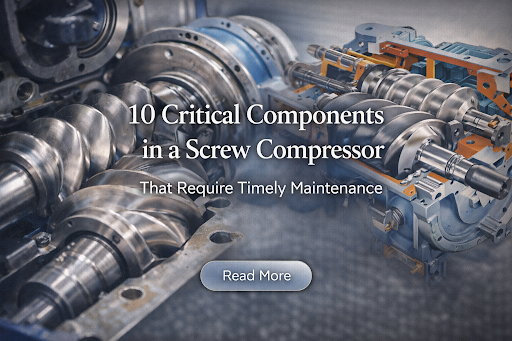
10 Critical Components in a Screw Compressor that Require Timely Maintenance

Critical Components in a Screw Compressor

A rotary screw compressor runs for thousands of hours in demanding industrial environments and is expected to deliver stable, clean compressed air. But it only performs that way when its key components are serviced on schedule. Skipping or delaying maintenance is one of the most common reasons plants face unexpected downtime and inflated repair bills.

Here are ten components that demand your attention. 

Air Filter

The air filter mainly protects a compressor against dust and particulates. A clogged filter increases the pressure differential at the inlet, forcing the machine to work harder and draw more energy. Inspect at every 500-hour service interval and replace as required, more frequently in dusty or polluted environments.

Oil Filter

The oil filter keeps the lubricant clean and protects the air-end from contaminants. Most manufacturers recommend replacement at every 2,000-hour service interval, though this may vary depending on operating conditions and the type of oil in use.

Air-Oil Separator

The separator removes oil from the compressed air before it reaches processing. Its service life is measured in operating hours and tracked by pressure drops. If the pressure differential exceeds 0.5 to 0.7 bar, it may require replacement. Under standard conditions, expect a service within 4,000 hours.

Compressor Oil

Oil degrades over time through heat, moisture, and contamination. Standard mineral oils typically require changing every 2,000 hours, while synthetic or extended-life oils may last up to 8,000 hours. Exceeding these intervals or using incorrect oil types accelerates wear significantly and can void your warranty.

Air-end Lubrication and Condition Monitoring

The air-end is the heart of a screw compressor. Monitoring oil condition, operating temperature, and vibration regularly helps catch early signs of wear before they become costly failures. Oil analysis every 1,000 hours is a sound practice in continuous-operation environments.

Minimum Pressure Valve (MPV)

The MPV maintains a minimum system pressure to ensure adequate lubrication during start-up and prevents air-end backflow. A stuck or worn MPV can cause pressure instability and oil carryover into the distribution network. Include an inspection in every 4,000-hour service.

Thermostatic Valve

This valve regulates oil temperature by controlling flow through the oil cooler. A faulty thermostatic valve leads to overheating or overcooling, both harmful to the air-end and oil life. 

Oil Cooler and Air Cooler

Blocked coolers cause compressor shutdowns triggered by high-temperature alarms. Both the oil cooler and aftercooler should be cleaned externally every 2,000 hours and inspected internally every 4,000 hours. 

Belt Tension and Coupling Alignment

Belt-driven compressors require periodic tension checks to prevent slippage and excess bearing load. Direct-drive units need coupling alignment verification. Either way, check them both at every 500-hour service to keep vibration in check and avoid premature wear on bearings and seals.

Electrical Connections and Safety Valve

Loose terminals cause heat build-up and motor failures. The safety (pressure relief) valve must be tested to confirm it opens at the correct rated pressure. Both should be part of every 2,000-hour service routine, yet they are frequently overlooked.

Stick to Hour-Based Preventive Maintenance

The most effective way to manage all the above is through a structured, hour-based PM schedule, typically at 500, 2,000, 4,000, and 8,000 hours. Each interval addresses specific checks and replacements suited to that stage of the compressor’s operating life. This approach reduces unplanned downtime, controls spare part costs, and extends equipment life considerably.

As trusted air compressor dealers in Mumbai, VEMC supports industries with genuine spares, expert servicing, and ELGi-authorised maintenance schedules.
Whether you need a routine service or a comprehensive audit, our team is ready to help. Contact your reliable air compressor dealer at +91 8976951701, +91 9819907445, 022 43117133, or email marketing@vemc.co.in.
Fire Pump Design in Data Centres: Role of MSMO, Split Case and Jockey Pumps

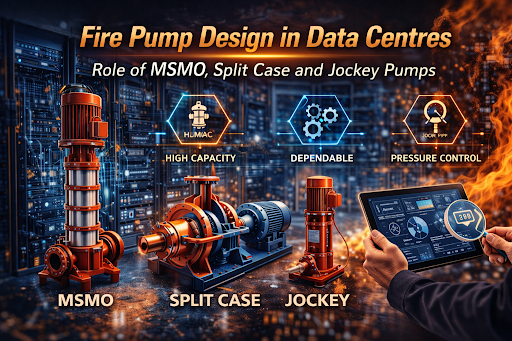
Fire Pump Design in Data Centres

Data centres house mission-critical infrastructure worth crores, operating 24×7 with zero tolerance for downtime. A fire in such a facility is not just a safety concern but a business continuity crisis. This is why fire pump design for data centres demands precision, redundancy, and reliability far beyond standard building requirements. As a trusted Kirloskar fire pump dealer, we have supported numerous data centre projects where getting the fire protection system right from the design stage was non-negotiable.

Accurate Flow and Head Calculation: The Foundation

Fire pump selection starts with calculating exact flow and head requirements based on facility layout, building height, sprinkler density, and hydrant coverage. Data centres typically require higher flow rates due to dense server racks, raised floors, and concentrated electrical equipment. Designers must account for friction losses across long horizontal pipe runs, elevation changes, and pressure drop through sprinkler systems and valves. 

Underestimating these parameters leads to inadequate coverage during emergencies, while oversizing wastes energy and capital. Detailed hydraulic modelling ensures the system delivers required flow and pressure at the remotest sprinkler head.

Understanding MSMO, Split Case, and Jockey Pumps

Data centre fire protection systems typically use three pump types working in coordination:

MSMO (Multi-Stage Multi-Outlet) pumps deliver high pressure through multiple impeller stages, making them suitable for tall data centres requiring a significant head. Their compact vertical design and ability to maintain steady pressure across varying flow conditions make them reliable for space-constrained critical applications.

Split case pumps are horizontal designs with the casing split along the centreline for easier maintenance access. They offer simpler servicing, higher flow capacity, and excellent efficiency at moderate to high heads. For large data centres with extensive sprinkler networks across multiple floors, split case pumps provide the volume and reliability needed.

Jockey pumps are small-capacity pumps that maintain system pressure continuously and compensate for minor leaks. Running at lower power, they prevent main fire pumps from starting unnecessarily, reducing wear on primary equipment. Typically sized at 3-5% of main pump capacity, they keep the system pressurised at required levels.

Redundancy and Reliability in Critical Systems

Data centres cannot afford single points of failure. Standards mandate redundancy through a main electric pump and standby diesel pump of equal capacity, both capable of achieving rated performance independently. Automatic transfer switches, dual power feeds, and backup batteries ensure pumps activate even during complete power outages. Working with a Kirloskar pump authorised dealer ensures pump coordination, firefighting control panels, and safety interlocks are configured correctly for seamless automatic failover.

Pressure Maintenance and System Stability

Stable pressure is critical in data centres. Fluctuating pressure can trigger false alarms, cause unintended sprinkler activation, further damaging equipment, or fail to deliver adequate flow during actual fire events. Jockey pumps maintain baseline pressure under normal conditions, while main pumps ramp up automatically during demand events. Proper pressure switch calibration, control panel programming, and regular testing ensure all pumps work in harmony. Suction conditions must be verified to avoid cavitation, which degrades pump performance and reliability.

Getting fire pump design right protects lives, critical assets, and business continuity. As an experienced Kirloskar fire pump dealer with deep expertise in critical infrastructure, VEMC supports data centre developments with compliant, reliable fire protection solutions. Contact us at +91 8976951701, +91 9819907445, 022 43117133 or email marketing@vemc.co.in for expert guidance.

Frequently Asked Questions

1. What is the purpose of a jockey pump?

It keeps the fire line pressurised and prevents unnecessary main pump starts.

2. Why are flow and head calculations important?

It ensures the pump can deliver the right pressure to every protected area.

3. Where are MSMO pumps used?

They are useful in multi-level buildings with more than one pressure zone.

4. Why choose a split case pump?

It handles high flow well and is easier to maintain.

How iHT Pumps Improve Energy Efficiency in HVAC Systems

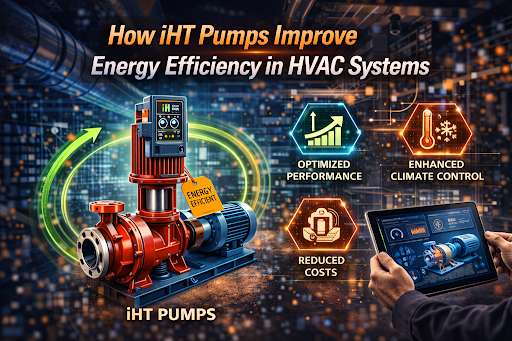
iHT Pumps Improve Energy Efficiency in HVAC Systems

How iHT Pumps Improve Energy Efficiency in HVAC Systems

HVAC (Heating, Ventilation, and Air Conditioning) systems account for nearly 40% of energy consumption in commercial buildings. Pumps circulating chilled or hot water through these systems play a critical role in overall efficiency. However, many installations rely on pumps that run inefficiently, consuming far more power than necessary. This is where iHT (intelligent Hydro Technology) pumps make a difference, delivering energy savings through smarter design and operation.

Understanding BEP and Its Impact on Energy Consumption

Every pump has a Best Efficiency Point (BEP), which is the specific flow and head combination where it operates most efficiently. At BEP, the pump delivers maximum output with minimum energy input and mechanical stress. Operating away from BEP increases power consumption, generates heat and accelerates wear on components like bearings and seals. 

In HVAC applications where pumps run continuously, even small deviations from BEP translate into significant annual energy waste. iHT pumps are designed to operate closer to BEP across varying load conditions, ensuring optimal performance and reduced electricity bills.

Matching Pump Curve to System Curve

A common mistake in HVAC design is selecting pumps without considering the system curve, which represents the relationship between flow rate and the pressure required to overcome friction losses in pipes, valves, and coils. When the pump curve does not match the system curve properly, the pump either overworks or underperforms. Oversized pumps waste energy by generating excess pressure that must be throttled using valves. Undersized pumps struggle to meet demand, causing comfort issues and equipment strain. iHT pumps address this through precise curve matching, ensuring the pump operates efficiently at the actual system operating point rather than at a theoretical maximum.

Variable Flow and VFD Integration

HVAC systems rarely operate at full load throughout the day. Cooling and heating demands fluctuate based on occupancy, weather, and time of use. Traditional fixed-speed pumps cannot adapt to these changes, running at full speed even when partial flow is adequate. This is where Variable Frequency Drives (VFDs) integrated with iHT pumps deliver substantial savings. 

VFDs adjust motor speed in response to real-time demand, reducing power consumption dramatically. Since pump power is proportional to the cube of speed, even a 20% reduction in speed can cut energy use by nearly 50%. iHT pumps with built-in VFD compatibility provide seamless variable flow operation, maintaining system pressure while consuming only the energy required for actual load conditions.

The Cost of Wrong Pump Selection

Selecting the wrong pump for an HVAC application creates long-term inefficiencies that extend beyond energy waste. Oversized pumps lead to short cycling, excessive vibration, and premature failure of mechanical seals. Undersized pumps cause temperature control issues, reduced comfort and higher maintenance costs due to continuous high-load operation. 

Incorrect pump selection also affects the entire system, causing valve wear, noise, and unstable pressure control. Consulting experienced industrial water pumps in Mumbai specialists ensure that pumps are sized correctly from the start, avoiding costly corrections later. VEMC, a trusted name among water pump dealers, offers expert guidance in selecting and integrating iHT pump solutions tailored to your HVAC requirements. 

Contact us at +91 8976951701, +91 9819907445, 022 43117133, or email marketing@vemc.co.in to explore energy-efficient pumping solutions for your facility.

Frequently Asked Questions

1. What is BEP and why does it matter for HVAC pumps?

BEP (Best Efficiency Point) is where a pump delivers maximum output with minimum energy use and mechanical stress.

2. How much energy can VFDs save on HVAC pumping systems?

VFDs can reduce energy consumption by up to 50% in variable-load applications by adjusting motor speed to match demand.

3. What happens if my HVAC pump is oversized?

Oversized pumps waste energy, cause excessive vibration and lead to premature seal failure and higher maintenance costs.

4. Can iHT pumps work with existing HVAC systems?

Yes, iHT pumps integrate easily into existing systems during upgrades or retrofits with proper sizing and curve matching.

5. How do I know if my pump is operating efficiently?

High energy bills, frequent maintenance, unstable pressure, noise or inconsistent temperature control indicate inefficient operation.

How Baseplate Distortion Leads to Repeated Alignment Failure

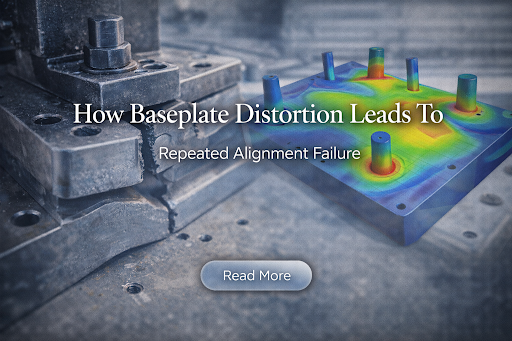
Baseplate Distortion Leads

When a pump keeps going out of alignment despite repeated corrections, the reason could be a distorted or misaligned baseplate. Many maintenance teams focus on the shaft and coupling, not realising that the very foundation holding the pump and motor in place has already shifted. Experts like VEMC understand this aspect clearly and how baseplate distortion develops can save time, money and effort in repairs.

The Structural Role of the Baseplate

The baseplate is the structural anchor for both the pump and the motor. It keeps both units fixed at the correct height, angle, and position so that their shaft centrelines remain precisely aligned. When the baseplate performs as intended, alignment holds. When it does not, no amount of shimming or adjustment will offer a lasting fix.

What is Baseplate Distortion?

Baseplate distortion refers to any warping, twisting, or bending that takes the baseplate out of its original flat, level plane. This can be subtle and often invisible to the naked eye, yet severe enough to cause permanent misalignment. Common causes include:

  • Poor grouting
  • Inadequate foundation support
  • Bent baseplate structure due to over-tightened anchor bolts
  • Residual welding stresses from fabrication
  • Pipe strain from poorly supported pipework connected to the pump
  • Thermal expansion due to high-temperature systems

Soft Foot vs. Structural Distortion

Soft footing occurs when one or more equipment feet do not sit flat on the baseplate, creating uneven loading. Structural distortion, by contrast, is a change in the baseplate geometry itself. Correctly identifying the root cause before attempting any corrections matters because both conditions can mirror each other during alignment checks. 

How Distortion Causes Repeated Misalignment

Once a baseplate distorts, the shaft centrelines of the pump and motor shift relative to each other. This introduces angular misalignment, where the shafts meet at an angle, and parallel misalignment, where the shafts run offset. Even when alignment is corrected during a shutdown, distortion causes it to drift back out of tolerance once the equipment returns to operating temperature and load. This pattern of repeated alignment failure after every correction is a reliable sign that the baseplate itself needs attention.

Impact on Pump Components

A misaligned pump does more than just wear faster. Baseplate-driven misalignment causes concentrated loading on bearings, accelerated seal wear and leakage, fatigue on shafts and couplings, increased vibration levels, and higher energy consumption. Over time, these effects compound into costly unplanned downtime and shortened equipment life.

Field Detection Methods

There are three methods to identify baseplate distortion in the field:

  • Laser alignment tools help reveal consistent drift patterns after repeated corrections.
  • Soft foot checks using dial gauges identify uneven contact between the feet and the baseplate surface.
  • Vibration analysis picks up characteristic frequencies associated with misalignment, helping identify mechanical symptoms and their root causes.

Preventive Practices and Long-Term Reliability

Getting the baseplate right at the installation stage is the most effective strategy. This means using proper grouting techniques, following controlled bolt torque procedures, specifying stress-relieved baseplates, and designing rigid foundations with adequate load distribution.

Routine inspections and alignment recheck after thermal cycling further protect long-term stability. The lifecycle cost benefit is significant: fewer breakdowns, lower maintenance expenditure and predictable equipment performance.

As trusted industrial pump suppliers in Mumbai and an authorised Kirloskar APOEM, VEMC offers expert guidance on pump installation, alignment verification, and preventive maintenance.

Contact us at +91 8976951701, +91 9819907445, 022 43117133, or email marketing@vemc.co.in.
The Evolution of Solar Panels: How Technology Made Solar Power More Efficient and Affordable

The Evolution of Solar Panels

Solar energy has become one of the most reliable and sustainable sources of power worldwide. Over the past few decades, continuous innovation in photovoltaic (PV) technology has significantly improved the efficiency and affordability of solar panels. Today, businesses and homeowners increasingly rely on solar energy, supported by experienced solar EPC companies in India.

Early Development of Photovoltaic Technology

The origins of solar power date back to the mid-20th century. Initially, solar panels were primarily used in space applications, especially for satellites because they could generate electricity without fuel. However, solar cells were extremely expensive back then, limiting their use to specialised applications.

Transition from Space to Commercial Use

As technology progressed and production methods improved, solar energy gradually moved from space applications to commercial use. Reduced costs and increasing environmental awareness encouraged businesses and governments to explore solar power as a viable energy option.

Evolution of Solar Cell Technologies

Early commercial solar panels mainly used monocrystalline and polycrystalline silicon cells. While effective, these technologies were less efficient than modern designs. Over time, advanced solar technologies have been introduced to maximise power generation. Innovations such as PERC (Passivated Emitter and Rear Cell), bifacial modules, TOPCon (Tunnel Oxide Passivated Contact), and HJT (Heterojunction Technology) have dramatically improved energy conversion. 

Improvements in Efficiency

Solar module efficiency has increased significantly over the years. Earlier solar panels typically delivered efficiencies of around 10–12%, whereas modern modules now commonly exceed 20%. This means more electricity can be generated from the same rooftop or land area.

Reduced Manufacturing Costs

A major reason for the rapid growth of solar energy is the reduction in manufacturing costs. Large-scale production, automation, and global supply chains have lowered the cost of solar panels dramatically. This has made solar installations more affordable and encouraged the growth of solar EPC companies in India.

Advancements in Inverters and System Components

Solar technology has also improved beyond the panels themselves. Modern inverter technologies and enhanced balance-of-system (BOS) components, including mounting structures, wiring, and monitoring systems, have improved the overall efficiency and reliability of solar power systems. 

Declining Cost of Solar Energy

The combination of technological innovation and large-scale deployment has significantly reduced the Levelized Cost of Energy (LCOE) for solar power. Today, solar energy is often cheaper than conventional electricity, making it an attractive long-term investment for businesses and industries.

Future of Solar Technology

Solar technology continues to evolve with innovations such as smart solar modules, advanced monitoring systems, and higher-efficiency cell technologies. These developments will further improve performance, reliability, and integration with energy storage and smart grids.

About VEMC

VEMC is a trusted solar EPC company in Mumbai offering comprehensive solutions for commercial and industrial clients. As one of the leading solar EPC companies in India with ISO 9001:2015 certification and CRISIL MSE-1 ratings, VEMC provides installation and maintenance services to help businesses transition to sustainable solar energy setups. Reach out to us on +91 8976951701, +91 9819907445, 022 43117133 or email marketing@vemc.co.in to learn more about our end-to-end solar services.