

Data centres house mission-critical infrastructure worth crores, operating 24×7 with zero tolerance for downtime. A fire in such a facility is not just a safety concern but a business continuity crisis. This is why fire pump design for data centres demands precision, redundancy, and reliability far beyond standard building requirements. As a trusted Kirloskar fire pump dealer, we have supported numerous data centre projects where getting the fire protection system right from the design stage was non-negotiable.
Accurate Flow and Head Calculation: The Foundation
Fire pump selection starts with calculating exact flow and head requirements based on facility layout, building height, sprinkler density, and hydrant coverage. Data centres typically require higher flow rates due to dense server racks, raised floors, and concentrated electrical equipment. Designers must account for friction losses across long horizontal pipe runs, elevation changes, and pressure drop through sprinkler systems and valves.
Underestimating these parameters leads to inadequate coverage during emergencies, while oversizing wastes energy and capital. Detailed hydraulic modelling ensures the system delivers required flow and pressure at the remotest sprinkler head.
Understanding MSMO, Split Case, and Jockey Pumps
Data centre fire protection systems typically use three pump types working in coordination:
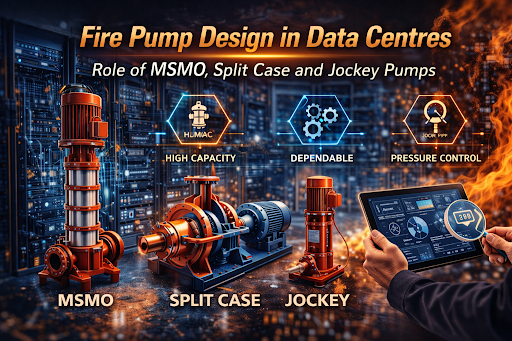
MSMO (Multi-Stage Multi-Outlet) pumps deliver high pressure through multiple impeller stages, making them suitable for tall data centres requiring a significant head. Their compact vertical design and ability to maintain steady pressure across varying flow conditions make them reliable for space-constrained critical applications.
Split case pumps are horizontal designs with the casing split along the centreline for easier maintenance access. They offer simpler servicing, higher flow capacity, and excellent efficiency at moderate to high heads. For large data centres with extensive sprinkler networks across multiple floors, split case pumps provide the volume and reliability needed.
Jockey pumps are small-capacity pumps that maintain system pressure continuously and compensate for minor leaks. Running at lower power, they prevent main fire pumps from starting unnecessarily, reducing wear on primary equipment. Typically sized at 3-5% of main pump capacity, they keep the system pressurised at required levels.
Redundancy and Reliability in Critical Systems
Data centres cannot afford single points of failure. Standards mandate redundancy through a main electric pump and standby diesel pump of equal capacity, both capable of achieving rated performance independently. Automatic transfer switches, dual power feeds, and backup batteries ensure pumps activate even during complete power outages. Working with a Kirloskar pump authorised dealer ensures pump coordination, firefighting control panels, and safety interlocks are configured correctly for seamless automatic failover.
Pressure Maintenance and System Stability
Stable pressure is critical in data centres. Fluctuating pressure can trigger false alarms, cause unintended sprinkler activation, further damaging equipment, or fail to deliver adequate flow during actual fire events. Jockey pumps maintain baseline pressure under normal conditions, while main pumps ramp up automatically during demand events. Proper pressure switch calibration, control panel programming, and regular testing ensure all pumps work in harmony. Suction conditions must be verified to avoid cavitation, which degrades pump performance and reliability.
Getting fire pump design right protects lives, critical assets, and business continuity. As an experienced Kirloskar fire pump dealer with deep expertise in critical infrastructure, VEMC supports data centre developments with compliant, reliable fire protection solutions. Contact us at +91 8976951701, +91 9819907445, 022 43117133 or email marketing@vemc.co.in for expert guidance.
Frequently Asked Questions
1. What is the purpose of a jockey pump?
It keeps the fire line pressurised and prevents unnecessary main pump starts.
2. Why are flow and head calculations important?
It ensures the pump can deliver the right pressure to every protected area.
3. Where are MSMO pumps used?
They are useful in multi-level buildings with more than one pressure zone.
4. Why choose a split case pump?
It handles high flow well and is easier to maintain.