

VEMC-Blogs

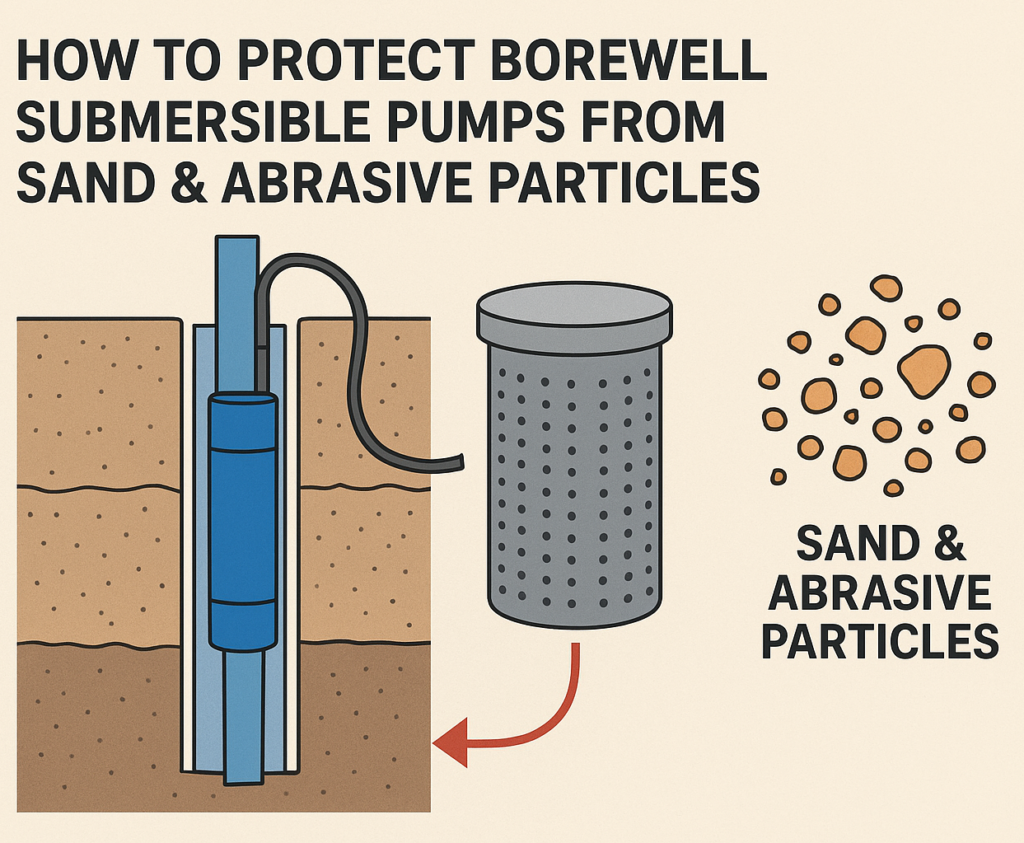
How to Protect Borewell Submersible Pumps from Sand & Abrasive Particles

Introduction

In many regions of India — including Maharashtra — borewells draw groundwater containing elevated levels of sand and other abrasive particles. When this gritty water passes through a submersible pump, it causes accelerated wear, reduced flow, frequent breakdowns and increased maintenance costs. This article explains why sand is a threat, and provides practical methods to protect your borewell submersible pump, maximise its lifespan and ensure uninterrupted water supply.

1. Why Sand & Abrasive Particles Damage Submersible Pumps

  • When sand enters the pump impeller or bearings, it abrades metal surfaces, causing erosion, vibration, imbalanced rotation and eventual failure.
  • Pumps installed in poorly screened boreholes often “pump sand” — a sign of mechanical stress and reduced lifetime.
  • In borewells with sandy formation or inadequate gravel packing, fine particles migrate into the casing and get drawn in under suction pressure.
  • Example: A case study from a farmer in Patna saw motor jamming due to sand ingress — the root cause being sand entering the pump motor assembly.

2. First Step: Assess Your Borewell Conditions

Before installing or servicing your pump, evaluate:

  • Sand content: Conduct a “bucket test” of pumped water, observe sand deposition after 30 minutes.
  • Screening/casing: Is there a well screen or gravel pack to reduce sand movement?
  • Water yield & dynamic level: Low yield can cause pump suction to pick up sand from the formation.
  • Pump placement depth: Pumps set too low in sandy formation risk sucking bottom sand.
  • Existing wear signs: Unusual noise, vibration, reduced flow, increasing current draw all point to abrasion.

3. Pre-Installation Measures to Mitigate Sand Entry

  • Install a gravel pack around the well casing: A layer of coarse gravel (~2-5 mm) around the screen helps trap fine sand and prevent it entering the pump suction.
  • Use a well screen with appropriate slot size: A stainless steel or PVC screen sized to prevent fine sand (e.g., <200 micron) migrating into the pump.
  • Casing integrity: Ensure the borewell casing is stable and free from collapsed sections which allow sand in.
  • Proper pump depth: Position the pump at the correct depth (above the sand or low yield zone) to avoid sand ingress.
  • Flush/develop the bore well post drilling to remove loose sand and debris prior to pump installation.

4. Choosing a Sand-Tolerant Submersible Pump

  • Select a pump with sand-handling capability: e.g., hardened impellers, abrasion-resistant materials (stainless steel, high-grade cast alloy) designed for sand-laden water.
  • Ensure the pump manufacturer gives specifications for maximum sand content (ppm or gram/litre) the pump can handle.
  • Use proper control devices: Motor protection, dry-run cut off, voltage stabiliser — when sand causes flow drop, these protect the motor.

5. Filtration & Separation Solutions to Remove Sand

  • Sand or grit separator (centrifugal type): Uses the pump’s flow to spin out heavier sand particles and discharge them separately, before water enters the pump.
  • Spin-down filters or mesh screen filters: Installed above ground or near the pumphead, trap sand and flush it off manually or automatically.
  • Routine flushing of separator: Regular check and emptying of sediment chamber ensures reliable operation.
  • Sediment filter after the separator: For extra protection, a fine mesh or cartridge filter can capture residual fines.

6. Maintenance Best Practices for Longevity

  • Schedule regular inspection of the intake screen, pump housing, cabling and motor current draw. Unusual vibration or current spike may mean sand damage.
  • Monitor sand deposition in the pump discharge: If sand starts appearing in water or settling in tanks, action is required.
  • Conduct wear inspections: Remove the pump yearly if feasible, inspect impeller, bearings, shaft for erosion.
  • Maintain water level sensors/dry-run cut-offs: When water level drops, suction increases, sand ingress risk increases.
  • Use voltage stabiliser/surge protection: Sand wear can cause increased load and motor overheating.

7. Troubleshooting Common Sand-Related Failures

ProblemLikely CauseSolution
Abrupt drop in flow rateSand clogging impeller or screenPull pump, inspect & clean screen/packing
Increasing motor current drawSand abrasion leading to bearing loadReplace impeller, use upgraded pump
Visual sand in discharge waterSand entering suctionImprove gravel pack, fit separator
Frequent motor trips / overheatingMotor straining due to sand loadInstall cut-off, check water levels

8. Why VEMC is Your Trusted Partner

At VEMC (Authorised Channel Partner for  Kirloskar Brothers Limited), we specialise in:

  • Assessing borewell sand conditions in Maharashtra & India
  • Recommending sand-handling submersible pumps and separators
  • Providing after-sales maintenance, inspections and retro-fits
  • Delivering cost-effective solutions that reduce downtime and extend pump life

Conclusion

Sand and abrasive particles are silent threats to borewell submersible pumps, especially in regions with sandy strata or high particulate content. By taking a proactive approach — evaluating borewell conditions, selecting the right pump, installing proper separation/filtration, and maintaining regularly — you can significantly extend your pump’s lifespan and reduce maintenance costs. Contact VEMC today to safeguard your borewell pump investment.

To learn more, speak with our expert team at VEMC for a site audit, pump assessment and tailored solution, email at marketing@vemc.co.in or call +91 9987099448


Why Every Workshop with Limited Floor Area Should Consider a Vertical Air Compressor

Vertical Air Compressor

In today’s industrial and workshop environments, efficient space utilisation is essential. Whether it’s a small garage, fabrication unit, or automotive service centre, every square foot matters. This is where getting a vertical air compressor from trusted compressor dealers offer a significant advantage. With their compact design and powerful performance, these vertical air compressors are ideal for workshops struggling with limited floor area.

Space Constraints in Small Workshops and Garages

Machinery, tools, and workbenches often occupy most of the available space in small-scale workshops. Traditional air compressors require a larger area, making it difficult to manage floor layouts efficiently. On the other hand, vertical air compressors are designed to fit into tight spaces while performing at maximum capacity.

Design Advantage: Minimal Footprint, Maximum Output

The key benefit of a vertical compressor lies in its upright tank-mounted design. By storing compressed air in a vertically oriented tank, these compressors occupy significantly less area while maintaining the same capacity as horizontal models. For workshops located in metropolitan cities like Mumbai, choosing compact machinery from trusted air compressor dealers in Mumbai can make a significant difference.

Same Power, Smaller Space

One common misconception about vertical compressors is that they are less powerful than horizontal ones. However, vertical compressors offer identical air output and performance in industrial setups. 

Better Shop Layout, Accessibility, and Safety

A vertical compressor allows for better workshop planning and accessibility. Since it occupies less floor space, it reduces clutter and enhances movement within the workspace. This design also promotes better safety as the compressor remains stable and protected against accidental impact or tripping hazards.

Ease of Installation and Maintenance

Another advantage of vertical compressors is their ease of installation and maintenance. Most models are designed with user convenience in mind featuring accessible service points, minimal piping requirements, and easy setup procedures. Routine maintenance tasks, such as oil checks, filter replacements, and tank drainages can also be carried out quickly.

ELGi Vertical Compressor Models: Ideal for Compact Setups

ELGi, one of the leading air compressor brands, offers a range of vertical tank-mounted compressors specifically engineered for compact spaces. These units combine energy efficiency, reliability, and robust design.

Real-World Applications

Vertical air compressors are widely used in:

  • Automotive garages and body shops for spray painting, tyre inflation, and pneumatic tools.
  • Fabrication units for powering grinders, welders, and drills.
  • Small manufacturing setups for assembly and packaging processes.

A vertical air compressor isn’t merely a space-saving alternative. It’s a great investment for workshops aiming to improve efficiency, safety, and workflow in their limited floor space. With reliable options offfered by trusted air compressor dealers like VEMC, businesses can ensure optimal performance even in confined workspaces. As an authorised ELGi air compressor dealer, VEMC offers end-to-end support for consultation, installation, after-sales service, and maintenance. Contact us on +91 8976951701+91 9819907445022 43117133 or email us at marketing@vemc.co.in to learn more about our comprehensive range of air compressor solutions.

Top 7 Reasons Why You Need a Pressure Boosting Pump in Modern Apartments

Pressure Boosting Pump in Modern Apartments

Residing in high-rise apartments has several perks. Starting from stunning views to modern amenities, you get peace of mind with secured living. But wait, there are some drawbacks that you cannot ignore. From a weak shower flow to a trickling tap, facing inconsistent pressure is extremely frustrating.

If you too face the same struggle of inconsistent supply, that’s a clear sign that you need a pressure boosting pump. These pumps ensure uniform water pressure across all floors, showers, taps, and appliances. Thus, now you don’t need to wait anymore for the tank to fill up. 

Get Rid of Low Water Pressure

In multi-story buildings, long pipe networks and gravity tend to reduce the water pressure. Especially on the upper floors. If your washing machine or shower systems struggle because of inconsistent supply, which is a clear sign you need a pressure boosting pump. It not only improves convenience but also protects your home’s plumbing from unnecessary strain.

Steady water flows every time

Appliances such as washing machines, geysers, and showers perform best when they receive consistent water pressure. Whether you are doing the laundry while someone’s showering or washing dishes during peak hours, the system ensures that it receives uninterrupted water flow.

Therefore, it improves convenience along with protecting your home’s plumbing from unnecessary strain.

Energy-Efficient and Whisper-Quiet Design

Today’s pressure boosting pumps are engineered to deliver high performance while consuming less power. Advanced motor designs ensure minimal noise, which makes them perfect for residential spaces. So, while your pump works hard behind the scenes, your home remains efficient and peaceful.

Smart and Automatic Operation

Manual control is no more in the scene. Nowadays, pressure boosting pumps come with automatic on and off features along with smart pressure sensors. It starts when water flow drops and stops when ideal pressure is achieved—all automatically. Ultimately, you save both effort and energy. Thus, this kind of automation is useful in apartments where multiple outlets are used simultaneously.

Easy Maintenance and Long-Term Reliability

When you choose a well-designed pressure boosting pump, you get the sense of relief that it requires minimal upkeep. Models that are from trusted industrial pump suppliers are built to withstand years of use with simple periodic maintenance. VEMC ensures that you get quick access to spare parts along with expert servicing. Hence, it ensures that your investment delivers consistent value over time.

Why Choose VEMC for Expert Solutions

Consistent water pressure is a necessity for comfortable urban living. A pressure boosting pump guarantees a steady flow of water, protects appliances, and enhances daily convenience.

VEMC, being one of the most trusted industrial water pump suppliers in Mumbai, offers a wide range of advanced pumps that are suited for residential and industrial needs.

For expert advice and installation support, reach out to us at: +91 8976951701 | +91 98199 07445 | 022 43436655 | 022 43117133 Email: marketing@vemc.co.in

Explore our full range of pressure boosting systems here.

Why Industries Are Switching to Zero Export Solar Systems

Zero Export Solar Systems

As industries move towards cleaner energy, solar power remains a top choice for reducing operational costs and carbon footprint. However, not every facility can feed excess solar energy back to the grid due to regulatory restrictions. That’s where Zero Export Solar Systems come in — a practical solution that allows industries to maximise solar energy usage without violating grid compliance norms.

What is a Zero Export Solar System?

A Zero Export Solar System is designed to ensure that no excess solar power generated at a site is exported to the utility grid. Instead, the energy is fully consumed within the premises. This is achieved through smart monitoring and control mechanisms that match solar generation with the site’s power demand in real time.

Leading solar EPC companies in Mumbai, like VEMC, are now increasingly implementing such systems for industries that need solar power without the complexity of export permissions.

Industrial Restrictions and Compliance Needs

In many industrial zones, grid export of solar energy is restricted by local regulations or utility providers. Exporting energy without proper permissions can lead to penalties or grid instability. To comply, businesses are adopting zero-export setups — a reliable middle ground that lets them harness solar energy without feeding it back to the grid.

How Export Limiters Work

A zero-export setup uses export limiters or controllers that continuously measure both solar generation and grid import. When solar production exceeds the facility’s consumption, the controller automatically adjusts inverter output to prevent reverse power flow to the grid. This ensures seamless compliance while maintaining optimal use of solar power.

Ideal Use Cases

Zero Export Solar Systems are particularly beneficial for factories with high daytime loads, where most of the generated solar energy is consumed instantly. They also work well in DG synchronisation setups, where solar energy supplements diesel generators, cutting down fuel consumption and emissions.

Key Advantages

Industries prefer zero-export configurations for their ease of approval, faster commissioning, and full solar utilisation. There’s no need for lengthy net metering approvals or utility permissions. By keeping energy consumption within the facility, businesses also gain independence from grid fluctuations and tariff uncertainties.

Partnering with a trusted solar EPC company in Mumbai ensures that the system is engineered precisely to site load patterns, offering maximum efficiency and reliability.

Ready to make the switch to sustainable, compliant, and cost-effective energy? Reach out to VEMC, one of the most trusted solar EPC companies in Mumbai, for customised Solar EPC services tailored to your industrial needs. Call us at +91 8976951701 | +91 98199 07445 | 022 43436655 | 022 43117133 or email marketing@vemc.co.in and take the first step towards smarter solar power management.

PMI Testing in Pump Maintenance: How It Helps Identify Counterfeit or Replaced Components

PMI Testing in Pump Maintenance

When it comes to industrial pump reliability, every component counts. Even a small mismatch in material can compromise performance, safety, and compliance. That’s where Positive Material Identification (PMI) testing steps in an advanced method used by experts like VEMC, one of the leading Kirloskar pump dealers in Mumbai, to verify the authenticity of pump materials and ensure long-term dependability.

What is PMI Testing?

PMI testing is a non-destructive technique used to determine the exact chemical composition of metal components. It helps confirm whether materials such as stainless steel, duplex steel, or special alloys used in pump casings, impellers, and shafts meet design specifications. In simple terms, it’s a way to “check the DNA” of your pump parts before they lead to costly issues.

Why Material Verification is Critical in Pumps

Pumps used across industries, from water treatment to chemicals — operate under extreme pressures and conditions. Their components must withstand corrosion, temperature changes, and continuous wear. If a counterfeit or substituted material is unknowingly installed, it could lead to premature failure, corrosion, or leaks. This makes material verification essential, particularly when sourcing spare parts from multiple vendors or when relying on local suppliers searched as ‘Kirloskar pump dealers near me.’

The Risks of Counterfeit or Mismatched Components

Counterfeit or replaced components pose serious risks. For instance, a pump impeller made from a cheaper alloy may corrode faster, affecting hydraulic efficiency and causing imbalance or vibration. Likewise, a mismatched shaft material might not have the required tensile strength, leading to cracks or failure under load. Such issues don’t just affect performance; they increase downtime, repair costs, and potential safety hazards.

How PMI Testing Works

PMI testing typically uses X-ray fluorescence (XRF) or optical emission spectroscopy (OES) to analyse a component’s composition. These portable instruments provide immediate results, allowing technicians to verify materials on-site without damaging the parts. The test identifies the elemental makeup, such as chromium, nickel, or molybdenum content and matches it against the original material specification.

Integrating PMI Testing into Maintenance

PMI testing is now a core part of preventive maintenance and quality audits. By incorporating it into regular inspection routines, service engineers can ensure that all critical components meet required standards. For example, during pump overhauls, PMI testing can confirm if an impeller has been replaced with an incorrect alloy, a common issue in chemical or water pumps.

The Benefits

Regular PMI testing offers multiple benefits: enhanced reliability, improved safety, regulatory compliance, and assurance of long-term performance. Partnering with trusted Kirloskar pump dealers in Mumbai, like VEMC, ensures that your pumps not only use genuine parts but are also supported by expert verification and maintenance practices that protect your investment for years to come.

For expert assistance with PMI testing, pump maintenance, or to ensure your systems use only authentic Kirloskar components, get in touch with our specialists today. Call us at +91 8976951701 | +91 98199 07445 | 022 43436655 | 022 43117133 or email marketing@vemc.co.in and let VEMC help you maintain pump reliability, safety, and long-term performance.