

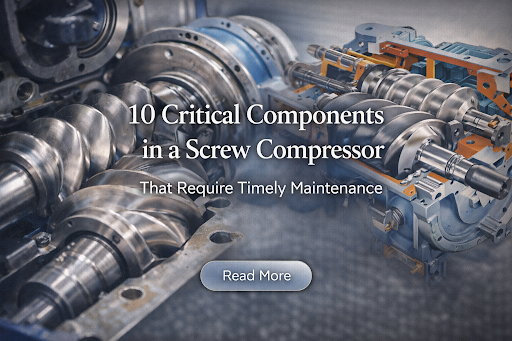
A rotary screw compressor runs for thousands of hours in demanding industrial environments and is expected to deliver stable, clean compressed air. But it only performs that way when its key components are serviced on schedule. Skipping or delaying maintenance is one of the most common reasons plants face unexpected downtime and inflated repair bills.
Here are ten components that demand your attention.
Air Filter
The air filter mainly protects a compressor against dust and particulates. A clogged filter increases the pressure differential at the inlet, forcing the machine to work harder and draw more energy. Inspect at every 500-hour service interval and replace as required, more frequently in dusty or polluted environments.
Oil Filter
The oil filter keeps the lubricant clean and protects the air-end from contaminants. Most manufacturers recommend replacement at every 2,000-hour service interval, though this may vary depending on operating conditions and the type of oil in use.
Air-Oil Separator
The separator removes oil from the compressed air before it reaches processing. Its service life is measured in operating hours and tracked by pressure drops. If the pressure differential exceeds 0.5 to 0.7 bar, it may require replacement. Under standard conditions, expect a service within 4,000 hours.
Compressor Oil
Oil degrades over time through heat, moisture, and contamination. Standard mineral oils typically require changing every 2,000 hours, while synthetic or extended-life oils may last up to 8,000 hours. Exceeding these intervals or using incorrect oil types accelerates wear significantly and can void your warranty.
Air-end Lubrication and Condition Monitoring
The air-end is the heart of a screw compressor. Monitoring oil condition, operating temperature, and vibration regularly helps catch early signs of wear before they become costly failures. Oil analysis every 1,000 hours is a sound practice in continuous-operation environments.
Minimum Pressure Valve (MPV)
The MPV maintains a minimum system pressure to ensure adequate lubrication during start-up and prevents air-end backflow. A stuck or worn MPV can cause pressure instability and oil carryover into the distribution network. Include an inspection in every 4,000-hour service.
Thermostatic Valve
This valve regulates oil temperature by controlling flow through the oil cooler. A faulty thermostatic valve leads to overheating or overcooling, both harmful to the air-end and oil life.
Oil Cooler and Air Cooler
Blocked coolers cause compressor shutdowns triggered by high-temperature alarms. Both the oil cooler and aftercooler should be cleaned externally every 2,000 hours and inspected internally every 4,000 hours.
Belt Tension and Coupling Alignment
Belt-driven compressors require periodic tension checks to prevent slippage and excess bearing load. Direct-drive units need coupling alignment verification. Either way, check them both at every 500-hour service to keep vibration in check and avoid premature wear on bearings and seals.
Electrical Connections and Safety Valve
Loose terminals cause heat build-up and motor failures. The safety (pressure relief) valve must be tested to confirm it opens at the correct rated pressure. Both should be part of every 2,000-hour service routine, yet they are frequently overlooked.
Stick to Hour-Based Preventive Maintenance
The most effective way to manage all the above is through a structured, hour-based PM schedule, typically at 500, 2,000, 4,000, and 8,000 hours. Each interval addresses specific checks and replacements suited to that stage of the compressor’s operating life. This approach reduces unplanned downtime, controls spare part costs, and extends equipment life considerably.
As trusted air compressor dealers in Mumbai, VEMC supports industries with genuine spares, expert servicing, and ELGi-authorised maintenance schedules.
Whether you need a routine service or a comprehensive audit, our team is ready to help. Contact your reliable air compressor dealer at +91 8976951701, +91 9819907445, 022 43117133, or email marketing@vemc.co.in.
