

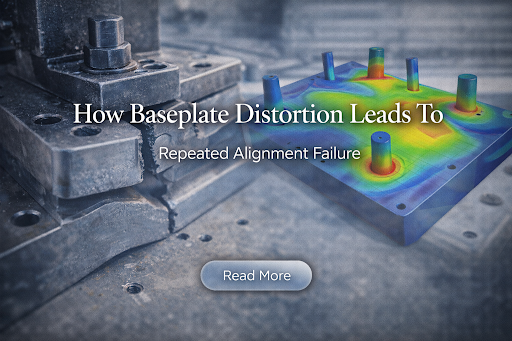
When a pump keeps going out of alignment despite repeated corrections, the reason could be a distorted or misaligned baseplate. Many maintenance teams focus on the shaft and coupling, not realising that the very foundation holding the pump and motor in place has already shifted. Experts like VEMC understand this aspect clearly and how baseplate distortion develops can save time, money and effort in repairs.
The Structural Role of the Baseplate
The baseplate is the structural anchor for both the pump and the motor. It keeps both units fixed at the correct height, angle, and position so that their shaft centrelines remain precisely aligned. When the baseplate performs as intended, alignment holds. When it does not, no amount of shimming or adjustment will offer a lasting fix.
What is Baseplate Distortion?
Baseplate distortion refers to any warping, twisting, or bending that takes the baseplate out of its original flat, level plane. This can be subtle and often invisible to the naked eye, yet severe enough to cause permanent misalignment. Common causes include:
- Poor grouting
- Inadequate foundation support
- Bent baseplate structure due to over-tightened anchor bolts
- Residual welding stresses from fabrication
- Pipe strain from poorly supported pipework connected to the pump
- Thermal expansion due to high-temperature systems
Soft Foot vs. Structural Distortion
Soft footing occurs when one or more equipment feet do not sit flat on the baseplate, creating uneven loading. Structural distortion, by contrast, is a change in the baseplate geometry itself. Correctly identifying the root cause before attempting any corrections matters because both conditions can mirror each other during alignment checks.
How Distortion Causes Repeated Misalignment
Once a baseplate distorts, the shaft centrelines of the pump and motor shift relative to each other. This introduces angular misalignment, where the shafts meet at an angle, and parallel misalignment, where the shafts run offset. Even when alignment is corrected during a shutdown, distortion causes it to drift back out of tolerance once the equipment returns to operating temperature and load. This pattern of repeated alignment failure after every correction is a reliable sign that the baseplate itself needs attention.
Impact on Pump Components
A misaligned pump does more than just wear faster. Baseplate-driven misalignment causes concentrated loading on bearings, accelerated seal wear and leakage, fatigue on shafts and couplings, increased vibration levels, and higher energy consumption. Over time, these effects compound into costly unplanned downtime and shortened equipment life.
Field Detection Methods
There are three methods to identify baseplate distortion in the field:
- Laser alignment tools help reveal consistent drift patterns after repeated corrections.
- Soft foot checks using dial gauges identify uneven contact between the feet and the baseplate surface.
- Vibration analysis picks up characteristic frequencies associated with misalignment, helping identify mechanical symptoms and their root causes.
Preventive Practices and Long-Term Reliability
Getting the baseplate right at the installation stage is the most effective strategy. This means using proper grouting techniques, following controlled bolt torque procedures, specifying stress-relieved baseplates, and designing rigid foundations with adequate load distribution.
Routine inspections and alignment recheck after thermal cycling further protect long-term stability. The lifecycle cost benefit is significant: fewer breakdowns, lower maintenance expenditure and predictable equipment performance.
As trusted industrial pump suppliers in Mumbai and an authorised Kirloskar APOEM, VEMC offers expert guidance on pump installation, alignment verification, and preventive maintenance.
Contact us at +91 8976951701, +91 9819907445, 022 43117133, or email marketing@vemc.co.in.